




What's Happening?
Lute Robotics, a company specializing in robotics tactile models, has successfully completed a total of $20 million in pre-seed and seed funding rounds. This significant investment was confirmed by ChainCatcher, citing Dealroom. The funding was contributed
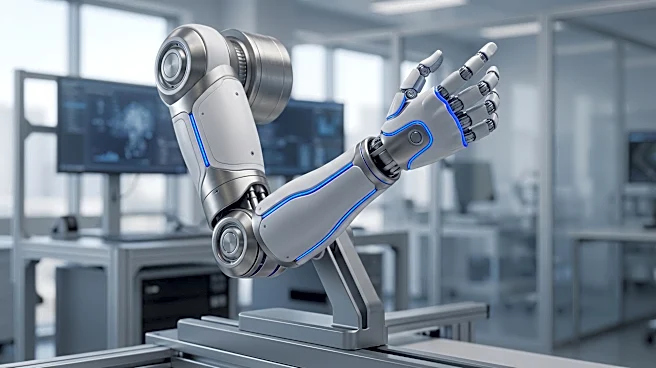
by several investors, including OTB Ventures, Seedcamp, Credo Ventures, Forward.one, and notable angel investor Naval Ravikant. Lute Robotics is focused on developing a deployment platform for physical AI. This platform integrates low-cost robotic arms and mobile humanoid robots from hardware partners with advanced robotics foundation models. The company's innovative approach includes a feedback loop that incorporates navigation, spatial memory, manipulation, and human feedback, enabling robots to enhance their capabilities through real-world operational experience. Lute Robotics aims to deploy its technology across various sectors, specifically targeting the logistics, manufacturing, and retail industries.
Why It's Important?
This substantial funding for Lute Robotics underscores a growing investor confidence in the physical AI and robotics sectors, particularly in technologies that promise to automate and optimize operations in critical industries. The involvement of prominent investors like Naval Ravikant signals a strong belief in the company's potential to disrupt traditional logistics, manufacturing, and retail processes. For the U.S. economy, advancements in robotics and AI can lead to increased efficiency, reduced operational costs, and enhanced productivity across these sectors. This could translate into more competitive domestic industries, potentially creating new job categories in robot maintenance, programming, and oversight, even as some manual labor roles may be automated. Companies that adopt Lute Robotics' solutions stand to gain a competitive edge through improved operational speed and accuracy, while those that fail to adapt might face challenges in keeping pace with technological advancements.
What's Next?
With the newly secured $20 million, Lute Robotics is expected to accelerate the development and deployment of its physical AI platform. The company will likely focus on refining its robotics foundation models and expanding its partnerships with hardware providers. The immediate next steps will involve further testing and integration of their feedback loop system to ensure robots can effectively learn and improve in diverse real-world environments. Lute Robotics will also likely intensify its efforts to penetrate the target markets of logistics, manufacturing, and retail, potentially through pilot programs or strategic collaborations with major players in these industries. The success of these deployments will be crucial in demonstrating the practical applicability and economic benefits of their advanced robotic solutions, paving the way for broader adoption and future funding rounds.
Beyond the Headlines
The rise of companies like Lute Robotics highlights a broader societal shift towards increased automation and the integration of AI into physical tasks. This development raises important ethical and societal questions regarding the future of work, the need for workforce retraining, and the potential for widening economic disparities if the benefits of automation are not broadly shared. Legally, the deployment of increasingly autonomous robots in workplaces will necessitate new regulations concerning safety, liability, and data privacy, especially as robots gather and process spatial and operational data. Culturally, the widespread adoption of humanoid robots could alter human-robot interactions and perceptions of labor. The long-term implications include a potential redefinition of human roles in industrial settings, emphasizing cognitive and creative tasks over repetitive physical labor, and a push towards more resilient and efficient supply chains.