




What's Happening?
Embo, a startup focused on developing artificial intelligence for general-purpose robots, has announced it has raised $110 million in seed funding. The funding round was led by Andreessen Horowitz (a16z), with additional participation from Khosla Ventures,
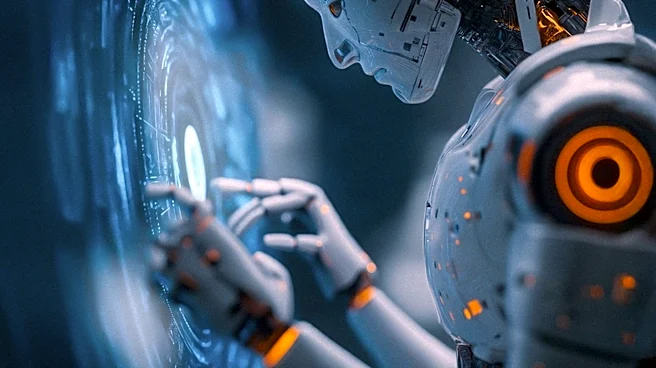
DST Global, and NVIDIA’s venture arm, NVentures. Embo's stated goal is to create 'the brain for intelligent robots' by developing AI models that possess a deep understanding of physical reality and fine-grained motor skills. The company plans to achieve this by training its robot AI on vast amounts of internet video, leveraging experience from its humanoid robot fleet, and utilizing practice within learned world models. This approach aims to enable robots to adapt to unfamiliar environments and recover from unexpected situations, such as a stuck drawer, without requiring specific demonstrations for every new scenario. The company's launch announcement, made on November 23, 2026, did not include quantitative robot benchmarks or details regarding the size or models of its robot fleet.
Why It's Important?
This significant seed funding for Embo highlights a growing investment trend in advanced robotics and artificial intelligence, particularly in developing more adaptable and intelligent robotic systems. The ability of robots to handle unfamiliar settings and self-correct errors could revolutionize various U.S. industries, including manufacturing, logistics, healthcare, and domestic services. By reducing the need for extensive, scenario-specific programming, Embo's technology could lower the barriers to robot deployment and increase their versatility in real-world applications. This could lead to enhanced automation, improved efficiency, and potentially address labor shortages in certain sectors. Investors like a16z see the potential for these AI-driven robots to move beyond repetitive tasks to more complex, dynamic environments, creating new market opportunities and driving innovation in the robotics sector. The success of such ventures could position the U.S. at the forefront of next-generation robotics development.
What's Next?
Following this substantial seed funding, Embo is expected to focus on further developing and refining its AI models and training methodologies. The company will likely expand its research and development efforts, potentially hiring more AI researchers and robotics engineers to accelerate its progress. The next steps will involve rigorously testing its unified AI model, which is pretrained on internet-scale data, fine-tuned with humanoid fleet experience, and post-trained through reinforcement learning in both simulated and real-world environments. While no specific product release dates or quantitative benchmarks have been provided, the company will likely work towards demonstrating the practical capabilities of its AI in handling diverse and unpredictable physical tasks. Future announcements may include details on pilot programs or partnerships with companies looking to integrate advanced robotic intelligence into their operations, aiming to validate the real-world performance and scalability of Embo's technology.
Beyond the Headlines
The development of highly intelligent, general-purpose robots capable of understanding physical reality and adapting to novel situations raises profound implications beyond immediate industrial applications. Ethically, as robots become more autonomous and capable of learning from their environments, questions about their decision-making processes, accountability in unforeseen circumstances, and their integration into human society will become increasingly pertinent. Legally, the framework for regulating such advanced robotic systems, particularly concerning safety, liability, and intellectual property generated by AI, will need to evolve. Culturally, the widespread adoption of robots that can perform complex tasks could shift societal perceptions of work, human-robot interaction, and the role of automation in daily life. This investment in Embo signifies a step towards a future where robots are not just tools but intelligent agents, potentially triggering long-term shifts in labor markets, ethical considerations in AI development, and the very fabric of human-machine coexistence.