




What's Happening?
The premiere episode of Amazon's new 'Fallout' TV series, based on the popular video game franchise, has been described as a bloated but promising start. The 60-minute episode attempts to introduce three distinct storylines, leading to a fragmented viewing
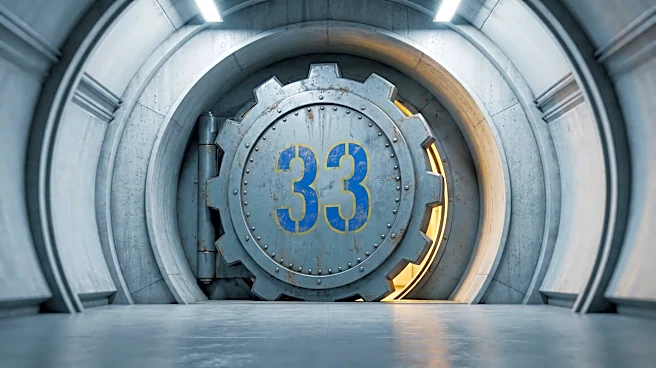
experience. The opening sequence, titled 'The End,' depicts the nuclear devastation that transforms the Los Angeles skyline into a panorama of mushroom clouds, focusing on Cooper Howard (Walton Goggins) and his daughter. The narrative then jumps 216 years forward to introduce Lucy (Ella Purnell), a Vault Dweller from Vault 33, whose sheltered existence is abruptly shattered by an attack from raiders. A third storyline, 'Maximus,' introduces a member of the Brotherhood of Steel, and 'The Ghoul' reveals Cooper Howard's post-apocalyptic transformation. While individual segments, particularly those focusing on Lucy and Cooper, show strong potential with their blend of black comedy and dramatic tension, the episode's attempt to juggle multiple narratives simultaneously is noted as a weakness, often undercutting the impact of key moments.
Why It's Important?
The launch of the 'Fallout' TV series is a significant event for the U.S. entertainment industry, particularly for streaming platforms and the adaptation of video game intellectual property. The series' success or failure could influence future investment in game-to-screen projects, impacting production studios, writers, and actors. For fans of the 'Fallout' game franchise, the adaptation represents a critical test of how well beloved lore and aesthetics translate to a new medium. The show's ability to capture the unique tone—a mix of retro-futurism, dark humor, and post-apocalyptic survival—is crucial for its reception. A successful adaptation could expand the franchise's audience beyond gamers, drawing in new viewers and potentially boosting sales of the original games and related merchandise. Conversely, a poorly received adaptation could lead to skepticism about future video game adaptations, affecting the broader trend of cross-media storytelling in Hollywood. The series also highlights the ongoing competition among streaming services to deliver high-quality, recognizable content to attract and retain subscribers.
What's Next?
The 'Fallout' series will continue to unfold, with subsequent episodes expected to delve deeper into the individual storylines introduced in the premiere. The critical reception of the initial episodes will likely influence audience engagement and the show's long-term trajectory. Viewers will be watching to see if the narrative structure becomes more cohesive and if the distinct tones of the various plotlines can be harmonized effectively. The performances of the lead actors, particularly Ella Purnell as Lucy and Walton Goggins as Cooper Howard/The Ghoul, will be key to maintaining audience interest. The series' ability to balance fan service with accessibility for newcomers will also be a factor in its success. Future episodes will need to build on the promising elements of the premiere while addressing the pacing and structural issues identified by critics. The show's performance will be closely monitored by Amazon and other streaming platforms as they evaluate strategies for adapting popular intellectual properties.
Beyond the Headlines
The 'Fallout' TV series, by bringing the post-apocalyptic world to a wider audience, has the potential to spark broader conversations about societal collapse, survival, and the human condition. The franchise's retro-futuristic aesthetic, which blends 1950s optimism with nuclear dread, offers a unique lens through which to explore themes of technological advancement, consumerism, and the consequences of war. The show's portrayal of Vault Dwellers, who have lived in sheltered underground communities, venturing into the harsh wasteland, can serve as a metaphor for confronting uncomfortable truths and adapting to radical change. The morally ambiguous nature of the 'Fallout' universe, where clear-cut heroes and villains are rare, encourages viewers to consider complex ethical dilemmas. This adaptation could deepen the cultural impact of the 'Fallout' narrative, moving it beyond the gaming community and into mainstream discourse, prompting reflections on historical anxieties and potential future scenarios.