




What's Happening?
BMW's Regensburg plant in Germany has undergone significant upgrades to prepare for the production of its next-generation electric vehicles (EVs), known as the Neue Klasse. A key part of this overhaul is the integration of a new 'Vormontage Energiemodule'
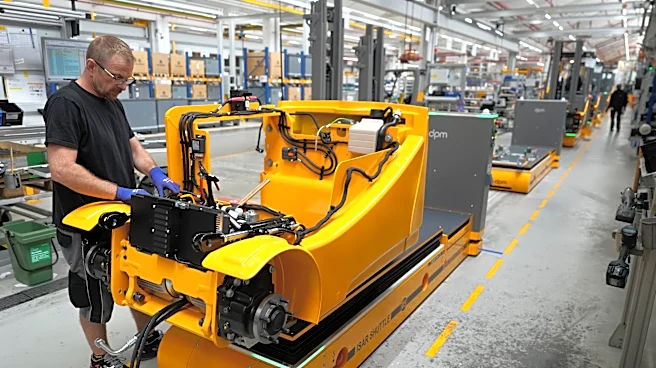
(VEM), or energy module pre-assembly, which BMW refers to as the 'battery marriage.' This new process involves joining the high-voltage battery to the vehicle's body at the beginning of the final assembly line, a departure from the traditional method of connecting the combustion engine. A new assembly line and a high-bay warehouse have been constructed to support this, with batteries automatically transported and secured to the body by robots, making the energy storage system an integral part of the vehicle's structure.
Why It's Important?
This strategic investment by BMW in its Regensburg plant signifies a fundamental shift in EV manufacturing processes. By integrating the battery directly into the vehicle's body early in the assembly, BMW is likely aiming to enhance structural rigidity, optimize weight distribution, and potentially improve crash safety and packaging efficiency for its Neue Klasse models. This 'battery marriage' approach is crucial for maximizing the performance and design potential of future EVs. It also demonstrates BMW's commitment to scaling up EV production and streamlining its manufacturing operations to accommodate both traditional and electric powertrains on the same lines. This flexibility is vital for the automotive industry's transition towards a mixed lineup of vehicles, ensuring efficient production as demand for EVs grows.
What's Next?
Production of Neue Klasse models at the Regensburg plant is expected to begin in the second half of this decade, with rumors suggesting the next-generation iX1 could enter production in November 2027. This new iX1 is anticipated to feature a rear-wheel-drive platform and cylindrical battery cells, promising greater range. The successful implementation of the new battery-to-body assembly process will be critical for the efficient rollout of these new EV models. BMW will continue to refine its manufacturing processes to ensure seamless integration of advanced EV technologies. The industry will be watching closely to see how this new assembly approach impacts vehicle performance, manufacturing costs, and overall production efficiency, potentially setting new benchmarks for EV manufacturing.
Beyond the Headlines
The 'battery marriage' concept at BMW's Regensburg plant represents more than just a manufacturing upgrade; it reflects a deeper architectural evolution in electric vehicle design. By making the battery a structural component, automakers can unlock new possibilities for vehicle dynamics, interior space, and overall vehicle integration. This approach could lead to lighter, safer, and more efficient EVs, fundamentally changing how cars are engineered and built. It also highlights the increasing importance of battery technology as the core of an EV, moving beyond a mere power source to a foundational element of the vehicle's structure. This shift could drive further innovation in battery design, materials, and manufacturing techniques across the automotive industry, ultimately accelerating the transition to electric mobility and shaping the future of personal transportation.