


What's Happening?
Ford Motor and Tesla, two major players in the automotive industry, have shown distinct revenue trends over recent quarters. Ford Motor has consistently generated higher revenue compared to Tesla, with figures such as $50.5 billion in Q3 2025 and $45.9
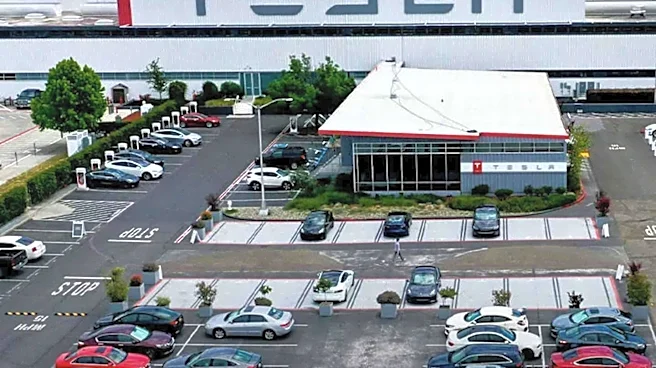
billion in Q4 2025. In contrast, Tesla's revenue, while lower, has been on an upward trajectory, reaching $28.2 billion in Q2 2026. Ford's revenue is primarily driven by its broad range of gas-powered vehicles, while Tesla focuses on electric vehicles (EVs) and energy solutions. Despite Ford's larger revenue base, Tesla's growth rate is significantly higher, with a 16% year-over-year increase in Q1 2026, accelerating to 26% in Q2 2026. This growth is attributed to Tesla's expansion in EV production and new ventures like the Cybercab at Gigafactory Texas.
Why It's Important?
The revenue trends of Ford and Tesla are significant as they reflect broader shifts in the automotive industry. Ford's stable revenue underscores its dominance in traditional vehicle markets, but its slower growth rate compared to Tesla highlights challenges in adapting to the EV market. Tesla's rapid growth suggests a strong market position in the EV sector, which is increasingly important as global demand for sustainable transportation rises. Investors and industry stakeholders are closely watching these trends, as they could influence future market dynamics and investment decisions. Ford's efforts to enter the EV market, including its Ford Energy division, indicate a strategic pivot, but Tesla's established presence and innovation in EVs and autonomous vehicles present formidable competition.
What's Next?
Looking ahead, the revenue gap between Ford and Tesla may continue to fluctuate as both companies pursue their respective strategies. Ford's focus on expanding its EV offerings and energy solutions could enhance its competitiveness, but it faces the challenge of achieving profitability in these areas. Tesla, on the other hand, is likely to continue its aggressive growth in EV production and autonomous vehicle technology, which could further increase its market share. The automotive industry is poised for significant transformation, and the actions of these two companies will be pivotal in shaping its future landscape.