






What's Happening?
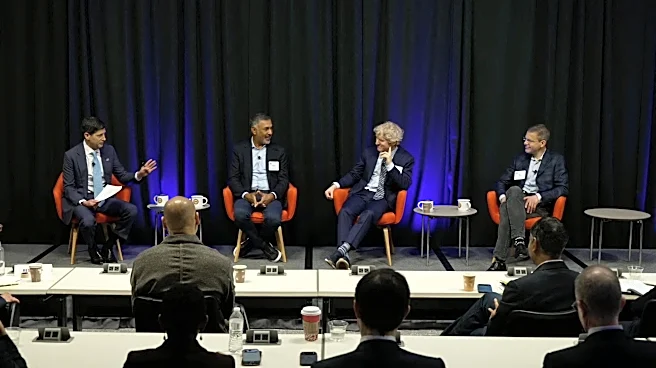
Hemant Taneja, CEO of venture capital firm General Catalyst, recently addressed the Cerebral Valley AI Summit in San Francisco, emphasizing the critical need for artificial intelligence to deliver both 'abundance' and 'agency.' Taneja articulated that
'agency without abundance' implies individuals benefit from AI without participating in the wealth it generates, while 'abundance without agency' suggests the creation of plentiful resources over which people have no say. He highlighted the current concentration of AI compute power, noting that approximately 75% is controlled by a limited number of companies. Taneja stressed the responsibility of those developing and funding AI to ensure that both abundance and agency become realities for a broader population. This perspective underscores a growing concern within the AI community regarding equitable access and control over the technology's benefits.
Why It's Important?
Taneja's remarks are significant because they address fundamental ethical and societal implications of AI development, particularly within the U.S. context. His call for both abundance and agency directly challenges the potential for AI to exacerbate existing wealth disparities and centralize power. If AI-driven wealth is not broadly distributed, it could lead to increased economic inequality, impacting social stability and public trust in technological progress. Conversely, if individuals lack agency over AI's applications, it could undermine democratic principles and personal autonomy. His emphasis on the concentration of compute power also highlights potential antitrust concerns and the need for regulatory frameworks that promote competition and prevent monopolistic control over this transformative technology. The venture capital community, as a primary driver of AI innovation, plays a crucial role in shaping these outcomes.
What's Next?
The discourse initiated by leaders like Hemant Taneja is likely to influence future investment strategies and policy discussions surrounding AI. Venture capital firms may increasingly consider the societal impact and equitable distribution of AI benefits when evaluating startups. Policymakers, particularly in the U.S., could use these arguments to inform regulations aimed at fostering broader participation in the AI economy and preventing excessive concentration of power. This could manifest in initiatives promoting open-source AI development, funding for AI literacy programs, or antitrust investigations into dominant AI companies. Furthermore, the conversation may encourage AI developers to prioritize user control and ethical considerations in their design processes, moving beyond purely profit-driven motives to incorporate social responsibility.
Beyond the Headlines
Taneja's framework of 'abundance and agency' delves into the deeper philosophical questions surrounding technological progress and human well-being. It suggests that the mere creation of advanced AI is insufficient; its true value lies in how it empowers individuals and contributes to a more equitable society. This perspective challenges the traditional Silicon Valley ethos of rapid innovation at all costs, urging a more thoughtful and inclusive approach. The long-term implications could involve a redefinition of success in the tech industry, where social impact and ethical governance become as crucial as financial returns. It also raises questions about the future of work, wealth distribution, and the very nature of human interaction with intelligent machines, pushing for a future where AI serves humanity rather than dominating it.