





What's Happening?
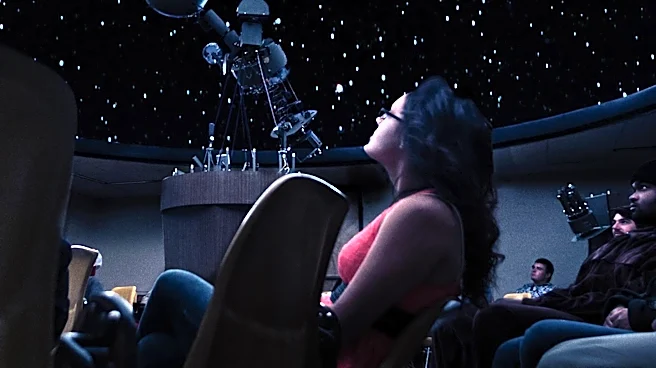
The Vanderbilt Museum and Planetarium on Long Island has introduced a new show called 'Alien Safari,' which explores the field of astrobiology and the search for extraterrestrial life. Developed by Erin Benitez, the planetarium's education coordinator,
the show transforms the planetarium theater into a spaceship, taking audiences on a journey to understand what makes a planet habitable. The show is designed for educational purposes, targeting fifth- to eighth-grade students, and has been showcased at various planetariums across the United States. 'Alien Safari' combines elements of chemistry, biology, astronomy, and physics to educate audiences about the requirements for life, such as water, energy, and the elements of CHNOPS (carbon, hydrogen, nitrogen, oxygen, phosphorus, and sulfur). The show also highlights the diversity of life on Earth, using examples of extremophiles that thrive in harsh environments, to speculate on what alien life might look like.
Why It's Important?
The 'Alien Safari' show is significant as it represents a modern approach to science education, combining entertainment with learning to engage audiences effectively. By focusing on astrobiology, the show highlights the interdisciplinary nature of scientific research and the ongoing efforts to discover life beyond Earth. This educational initiative not only informs the public about the scientific methods used to search for extraterrestrial life but also inspires interest in STEM fields among young students. The success of the show underscores the importance of innovative educational programs in making complex scientific concepts accessible and exciting to a broader audience.