







What's Happening?
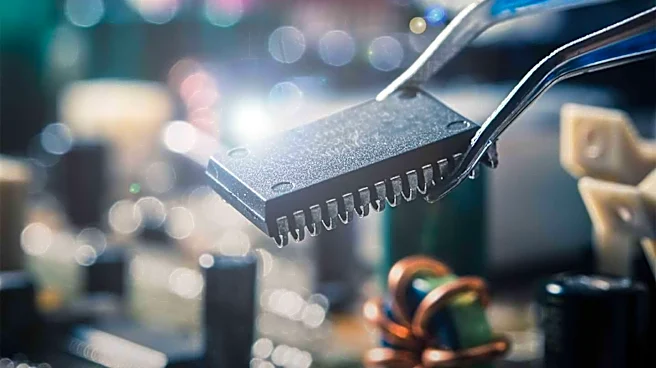
Meta is commencing mass production of its in-house 'Iris' AI chip in September 2026, marking a significant step in its Meta Training and Inference Accelerator (MTIA) program. This move positions Meta as a major hyperscaler developing its own custom silicon
to power AI systems across Facebook, Instagram, and WhatsApp, including recommendation engines, ad ranking, and generative AI features. The Iris chip is the first mass-production 'training-class' product from MTIA, a notable advancement from previous inference-focused chips. Meta's internal memo indicates a target of 7 gigawatts of AI computing capacity by the end of 2026, doubling to 14 gigawatts in 2027, with this growth directly tied to the deployment of Iris and future MTIA generations. While Nvidia currently holds an estimated 80% to 85% of the data center AI accelerator market, custom ASIC growth is projected at 44.6% for 2026, nearly three times the 16.1% growth for merchant GPUs. Broadcom designed the Iris chip, and TSMC is handling manufacturing, placing Iris in direct competition with Nvidia's next-generation Rubin chips for leading-edge manufacturing capacity.
Why It's Important?
Meta's mass production of the Iris AI chip signifies a strategic shift among major U.S. hyperscalers to reduce their reliance on external GPU suppliers like Nvidia and AMD. This initiative is driven by a desire for cost control and supply chain stability. By designing custom chips tailored to their specific workloads, companies like Meta aim to optimize efficiency and reduce the high margins associated with merchant GPUs. This trend could reshape the AI supply chain, influencing how AI infrastructure is funded, built, and priced. The competition for TSMC's advanced manufacturing capacity between custom silicon like Iris and Nvidia's offerings highlights a growing bottleneck in the industry. For Nvidia, while its market share remains dominant, the increasing adoption of in-house chips by its largest customers means a growing portion of their compute budget will be diverted internally, potentially slowing Nvidia's growth in the long term. This development also underscores the bifurcation of the AI hardware market into merchant GPUs for general use and custom ASICs for hyperscalers, creating two distinct growth trajectories.
What's Next?
The success of Meta's Iris chip and its ability to meet the ambitious 7-gigawatt target by the end of 2026, and 14 gigawatts by 2027, will be closely watched. If Meta achieves these goals, it could prompt other hyperscalers like Google, Amazon, and Microsoft to disclose their own custom silicon targets with similar specificity, intensifying the race for in-house AI hardware. The competition for TSMC's advanced node capacity will likely become a critical limiting factor for how quickly any hyperscaler can scale custom silicon. Nvidia's market share is projected to gradually ease towards 75% by the end of 2026 as custom ASICs and AMD's MI-series GPUs gain traction. Inference workloads are expected to migrate to custom silicon faster than training workloads, which may continue to rely on Nvidia and AMD GPUs due to their software and flexibility advantages. The long-term trend points towards a more diversified AI hardware landscape, with hyperscalers increasingly building their own specialized solutions while still utilizing merchant GPUs for broader applications.
Beyond the Headlines
The move by Meta and other hyperscalers to develop custom AI chips has profound implications beyond immediate cost savings and supply chain control. It represents a fundamental shift in the power dynamics of the AI industry, where the largest consumers of AI compute are becoming producers of their own specialized hardware. This vertical integration allows these companies to exert greater control over their technological destiny, potentially fostering innovation tailored to their unique needs and data sets. However, it also raises questions about interoperability and standardization within the AI ecosystem. As more custom chips emerge, the industry might see a fragmentation of hardware architectures and software stacks, potentially creating new challenges for developers and smaller companies that rely on standardized platforms. This trend could also exacerbate the divide between well-resourced hyperscalers and other enterprises, as the ability to design and manufacture custom silicon requires immense capital and expertise, further concentrating power within a few tech giants.