





What's Happening?
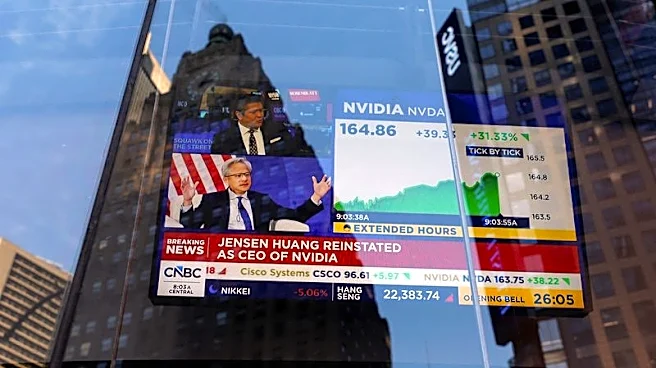
Walter Isaacson, author of the 'Elon Musk' biography, Tulane University professor, and Perella Weinberg advisory partner, has publicly stated that the reinstatement of Jensen Huang as CEO of Nvidia is a 'long-term mistake' for the company. Isaacson shared
his views on CNBC's 'Squawk Box,' discussing the implications of Huang's return and the future trajectory of Nvidia. His comments come amid broader discussions and scrutiny surrounding Nvidia's leadership and corporate governance. Isaacson's perspective suggests a critical view of the decision, implying potential negative consequences for Nvidia over an extended period, despite the immediate market reactions or perceived benefits of Huang's return.
Why It's Important?
Walter Isaacson's critique of Jensen Huang's reinstatement as Nvidia CEO carries significant weight due to Isaacson's prominent background as a biographer of influential figures and his expertise in business and technology. His assessment could influence investor sentiment and spark further debate among corporate governance experts and market analysts regarding Nvidia's leadership strategy. While the immediate market reaction to Huang's return might be positive, Isaacson's 'long-term mistake' assertion suggests concerns about sustained innovation, strategic direction, or potential governance issues that might not be immediately apparent. This perspective challenges the conventional wisdom that the return of a visionary founder is always beneficial, prompting a deeper examination of the complexities of corporate leadership and succession planning in high-tech companies like Nvidia, which plays a crucial role in the AI and semiconductor industries.
What's Next?
Isaacson's comments are likely to fuel ongoing discussions about Nvidia's corporate governance and leadership stability. While Nvidia's board has made its decision, external critiques from influential figures like Isaacson can prompt increased scrutiny from investors, analysts, and the media. The company will likely continue to operate under Jensen Huang's leadership, focusing on its strategic objectives in the semiconductor and AI markets. However, the long-term implications suggested by Isaacson will be a point of observation for stakeholders. Future performance, strategic decisions, and any potential governance challenges at Nvidia will likely be viewed through the lens of such criticisms, with observers looking for evidence that either validates or refutes Isaacson's prediction of a 'long-term mistake.' The company's ability to maintain its market leadership and innovation trajectory under Huang's renewed tenure will be key.
Beyond the Headlines
Isaacson's remarks delve into the complex dynamics of founder-led companies and the challenges of leadership transitions. While founders often bring unique vision and drive, their prolonged or reinstated leadership can sometimes lead to questions about succession planning, board independence, and the potential for insular decision-making. The 'long-term mistake' argument could imply concerns about whether Huang's return stifles new leadership development, limits strategic diversification, or creates an over-reliance on a single individual. This broader discussion is crucial for the tech industry, where many companies are still led by their founders. It highlights the tension between leveraging a founder's genius and ensuring robust, sustainable corporate governance that can adapt to evolving market conditions and leadership needs. The debate around Nvidia's leadership could serve as a case study for other tech giants grappling with similar issues.