


What's Happening?
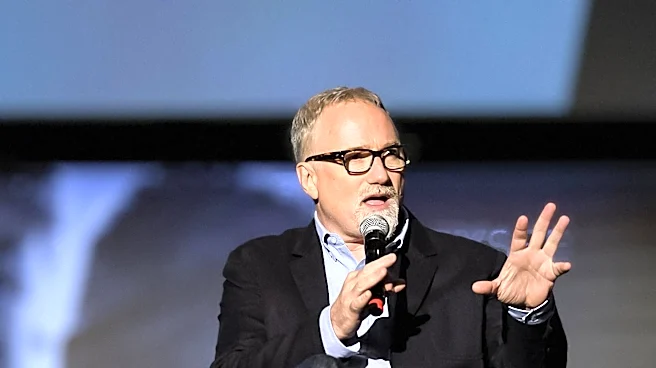
Director David Fincher has drawn criticism for his extensive use of artificial intelligence (AI) in his latest film, 'The Further Mis-Adventures of Cliff Booth,' a standalone sequel to Quentin Tarantino’s 'Once Upon a Time in Hollywood.' Fincher confirmed
in an interview on The Ringer’s Big Picture podcast that AI was employed to synchronize actors' line readings with their performances, specifically to adjust lip movements in post-production. He stated that 95% of dialogue replacement in the film was done using AI, significantly reducing the need for multiple takes and conventional re-recording sessions. Beyond the current film, Fincher also outlined a 'dystopian' vision for future filmmaking, where AI would handle many technical aspects like focus, dolly shots, and even minor details like hair placement, allowing actors to perform scenes fewer times. This approach, which he described as 'freeing,' aims to achieve a 'perfect' performance by combining the best visual and auditory elements through AI manipulation.
Why It's Important?
The controversy surrounding David Fincher's use of AI in 'The Further Mis-Adventures of Cliff Booth' highlights a growing tension within the U.S. entertainment industry regarding the role of artificial intelligence in creative processes. This development is significant because it directly impacts actors, crew members, and the perceived authenticity of cinematic performances. Critics argue that AI-driven alterations to an actor's performance, such as lip-syncing adjustments, undermine the integrity of their craft and could lead to a 'Frankenstein-ing' of performances that were never truly given on set. This raises concerns about job security for various film professionals, including those involved in traditional post-production and even acting, as AI could potentially reduce the demand for extensive on-set work. The debate also touches upon the definition of 'art' in filmmaking, with some arguing that the imperfections and 'accidents' of human performance are what make it art, a quality that AI-driven 'perfection' might erase. The industry is currently grappling with how to balance technological advancement and cost-cutting with maintaining human creativity and ethical considerations, especially in the wake of recent layoffs and AI disruption in Hollywood.
What's Next?
The widespread criticism of David Fincher's AI usage and his future vision for filmmaking suggests that the debate over AI in Hollywood will intensify. This incident is likely to fuel further discussions among industry guilds, unions, and creative professionals about establishing clear guidelines and ethical boundaries for AI implementation. There could be increased pressure for transparency regarding AI's role in film production, potentially leading to demands for disclosure in film credits or marketing materials. The backlash may also influence award considerations, with some critics already calling for films utilizing AI to be disqualified. As 'The Further Mis-Adventures of Cliff Booth' becomes available on Netflix, audience reception to the AI-enhanced performances will be closely watched, potentially shaping future investment and adoption of similar technologies by other studios and directors. The broader entertainment industry will continue to explore how to integrate AI while addressing concerns about job displacement, creative control, and the authenticity of artistic expression.
Beyond the Headlines
Beyond the immediate controversy, Fincher's comments illuminate a deeper philosophical shift in the creative arts, particularly concerning the pursuit of 'perfection' through technological means. His vision of a filmmaking process where human performance is extensively refined and manipulated by AI raises questions about the very nature of artistic authorship and the value of human imperfection. If AI can seamlessly combine the 'best' elements of multiple takes to create a composite performance, it blurs the line between an actor's genuine contribution and a technologically constructed ideal. This could lead to a devaluation of the raw, spontaneous aspects of acting and directing, favoring a more controlled, manufactured outcome. Ethically, it prompts discussions about consent and the digital 'ownership' of an actor's likeness and performance data. Culturally, it reflects a broader societal trend towards optimization and efficiency, even in domains traditionally valued for their human element. The long-term implications could include a redefinition of what constitutes a 'director's cut' or an 'actor's performance,' potentially leading to new legal frameworks and artistic conventions to address these evolving creative practices.