




What's Happening?
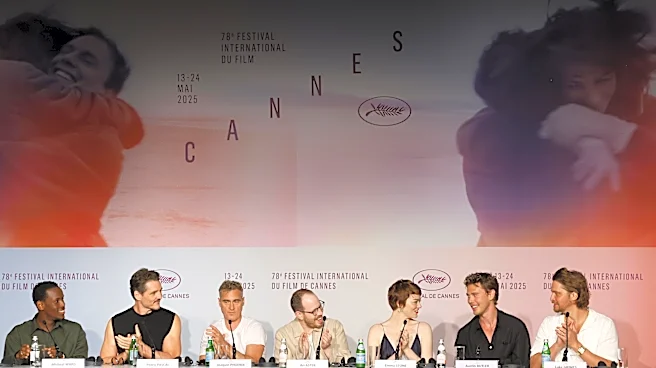
Bi Gan's film 'Resurrection' has been awarded the Special Prize at the 78th Cannes Film Festival. The production of this film notably incorporated advanced virtual location scouting and previsualization techniques. Bi Gan's crew utilized 3D scans of real-world
locations, some situated three hours from their base, to meticulously plan the film's extensive single-take finale. This innovative approach allowed the team to conduct virtual scouting, previsualization, and VFX shot planning, as well as gather asset references without needing to physically visit the distant sites repeatedly. The film, which explores a world where humanity has lost the ability to dream, features a single take that spans over half an hour, culminating in a rain-soaked city scene on New Year’s Eve 1999. This method proved crucial for coordinating complex elements like blocking, set dressing, camera paths, and lighting for a shot that required precise execution and limited on-set attempts.
Why It's Important?
The recognition of 'Resurrection' at the Cannes Film Festival, coupled with its innovative production methods, highlights a significant shift in filmmaking practices. The adoption of virtual location scouting and 3D previsualization, as demonstrated by Bi Gan's team, offers substantial benefits to the film industry. This technology can drastically reduce the time and cost associated with traditional location scouting, especially for remote or difficult-to-access sites. It also enhances precision in planning complex shots, minimizing errors and the need for multiple takes, which is particularly valuable for ambitious sequences like the film's half-hour single shot. This approach allows for more detailed collaboration among various departments—direction, art, lighting, and camera—in a shared virtual environment, leading to more cohesive and efficient production workflows. The success of 'Resurrection' could encourage broader adoption of these technologies, potentially democratizing access to challenging locations and enabling more creative and technically ambitious cinematic projects across the U.S. and global film industries.
What's Next?
The success of 'Resurrection' and its production methodology is likely to spur increased interest and investment in virtual production technologies within the film industry. Filmmakers and studios may explore integrating 3D scanning, virtual scouting, and advanced previsualization tools into their standard production pipelines. Technology providers like XGRIDS, whose Lixel L2 Pro scanner and LCC Studio software were used for 'Resurrection,' could see a rise in demand for their services and products. This trend could lead to further innovation in virtual production, potentially making it more accessible and cost-effective for a wider range of productions, from independent films to major studio blockbusters. The industry might also see new training programs and skill sets emerge to support these evolving production techniques, impacting film schools and professional development for crew members.
Beyond the Headlines
The embrace of virtual location scouting in 'Resurrection' points to a broader technological transformation in creative industries. Beyond mere efficiency, this approach allows filmmakers to maintain a connection to 'real locations' that might otherwise be deemed too impractical or expensive to use. This paradox—using advanced technology to stay closer to physical reality—could redefine authenticity in cinema. It raises questions about the future of on-location shooting versus digitally enhanced or created environments. Furthermore, the ability to meticulously plan and rehearse complex scenes virtually could empower directors to push creative boundaries, attempting shots and sequences that were previously considered impossible due to logistical constraints. This shift could also have environmental implications, reducing the carbon footprint associated with extensive travel for location scouting and on-set logistics.