







What's Happening?
The cinematic adaptations of J.R.R. Tolkien's 'The Lord of the Rings' by Peter Jackson notably excluded a significant narrative arc from the books: 'The Scouring of the Shire.' This arc, which occurs in the latter half of 'The Return of the King' after
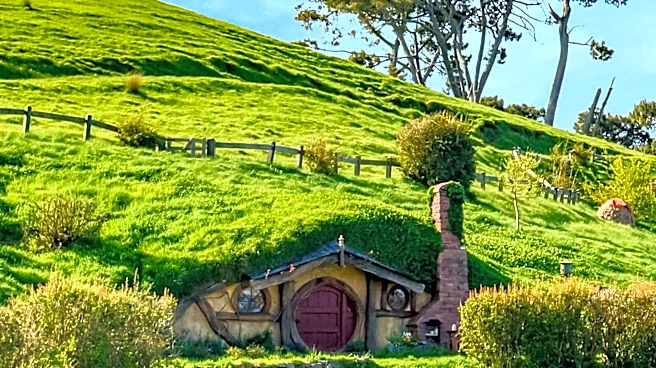
the destruction of Sauron, depicts the Hobbits returning to find their homeland corrupted by Saruman's forces. The Shire has been transformed into a police state, with food shortages, industrial pollution, and repression enforced by 'Big Men' and compliant Hobbit 'Sheriffs.' The Hobbits of the Fellowship, particularly Merry and Pippin, lead their community in a battle to reclaim their home, utilizing the skills and experiences gained during their epic journey. Frodo and Sam also play crucial roles, with Frodo advocating for mercy and Sam expressing the need for retribution against the invaders. This sequence culminates in the defeat of Saruman, who is ultimately killed by his servant Wormtongue.
Why It's Important?
The omission of 'The Scouring of the Shire' from the films significantly alters the thematic depth of 'The Lord of the Rings.' In the books, this arc serves as the true final battle, emphasizing the impact of evil on common people and the power of ordinary individuals to resist corruption. It highlights themes of humility, perseverance, community, and the importance of simple pleasures like good food and friendship, which are central to Tolkien's vision. By cutting this section, the films shift the focus primarily to grand, epic battles and the destinies of kings and magical beings, potentially diminishing the narrative's exploration of the everyday consequences of war and the resilience of the common folk. The book's ending underscores that even after the defeat of a great evil, the fight for one's home and values continues, a message that resonates with the struggles of ordinary citizens against oppressive forces.
What's Next?
While the Peter Jackson films have concluded, the ongoing and future adaptations of 'The Lord of the Rings' multimedia franchise, including Amazon's 'The Rings of Power' and upcoming projects like 'The Lord of the Rings: The Hunt for Gollum' and 'The Lord of the Rings: Shadows of the Past,' could potentially explore or reference elements of 'The Scouring of the Shire.' However, given the established cinematic narrative, a direct adaptation of this specific arc in future film projects seems unlikely. The focus of new adaptations may continue to lean towards the more fantastical and large-scale conflicts, similar to the original film trilogy's approach. Fans of the books will likely continue to discuss and debate the significance of this omitted storyline and its implications for the overall interpretation of Tolkien's work.
Beyond the Headlines
The decision to exclude 'The Scouring of the Shire' from the film trilogy raises broader questions about adaptation and the choices made when translating complex literary works to the screen. Filmmakers often face constraints related to runtime, budget, and narrative streamlining, which can lead to the omission of elements deemed less critical to the main plot. However, in this case, the omitted arc is argued to be a cornerstone of Tolkien's ideology, illustrating the enduring nature of evil and the necessity of local, grassroots resistance. This highlights a tension between commercial viability and artistic fidelity, where the 'epic' often takes precedence over the 'mundane' yet profoundly meaningful aspects of a story. The ongoing discussion among fans about this omission reflects the deep connection audiences have with the source material and their expectations for faithful adaptations.