




What's Happening?
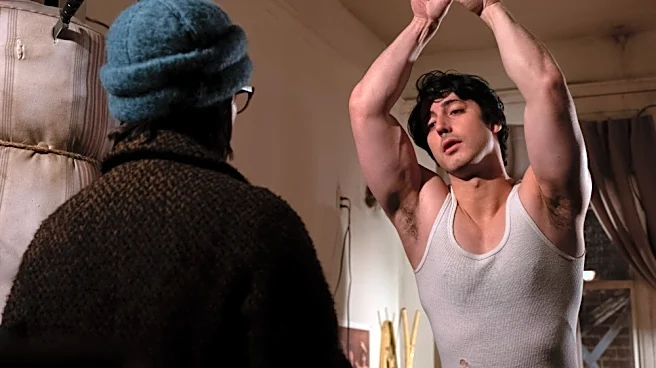
The Academy of Motion Picture Arts and Sciences' Writers Branch executive committee is set to determine whether the screenplay for 'I Play Rocky' will compete in the Best Original Screenplay or Best Adapted Screenplay category for the upcoming 99th Oscars.
This decision is crucial as it impacts the film's awards campaign strategy. The film, which dramatizes the real story of how Sylvester Stallone created 'Rocky,' opened in limited release on November 6, 2026, and is scheduled for nationwide expansion on November 20, 2026. The Academy's rules state that a script is generally adapted if it is based on credited intellectual property, pre-existing characters, or previously published work. Conversely, a script is considered original if it stems from myth, legend, or the writer's own unpublished work. For true stories, the Academy classifies them as adapted if they have a credited source like a book or documentary, and original if the writer conducted the research across multiple sources independently. Peter Gamble wrote the 'I Play Rocky' script on spec, with no credited book, article, or documentary. However, the film features characters from the 1976 'Rocky' film, and Amazon MGM owns the franchise, complicating the classification.
Why It's Important?
The Academy's decision on the screenplay category for 'I Play Rocky' holds significant weight for its Oscar campaign and could influence its chances of securing a nomination and win. The Best Original Screenplay and Best Adapted Screenplay categories often have different competitive landscapes, with varying numbers of strong contenders. A placement in one category over the other could either ease or intensify the film's path to recognition. For instance, the original screenplay category for the current awards season is already considered crowded with films like 'Wild Horse Nine' and 'The Debut,' while the adapted category includes 'The Odyssey' and 'Dune: Part Three.' This ruling also sets a precedent for how the Academy interprets its own guidelines regarding films that blend true stories with existing intellectual property. The Writers Guild of America (WGA) often classifies scripts differently from the Academy, as seen with 'Barbie' and 'Moonlight,' which can create discrepancies in how films are recognized across various awards. The outcome will be closely watched by filmmakers, studios, and awards strategists as it impacts how similar projects might be positioned in future awards cycles.
What's Next?
The Academy's Writers Branch executive committee will make its final, unappealable decision on the category placement for 'I Play Rocky.' This ruling will be publicly revealed when the Oscar nominations are announced on January 21, 2027. In the interim, the film will continue its theatrical run, expanding nationwide on November 20, 2026, which will be a critical period for building audience and critical momentum. The Writers Guild of America (WGA) will also conduct its own classification process, with screenplay submissions closing on November 20, 2026, and nominees announced on January 8, 2027. While the WGA's decision does not bind the Academy, it often provides an indication of industry sentiment. Awards handicappers and film critics will be closely analyzing the committee's decision, as it will significantly shape the film's trajectory through the awards season. The film has already garnered positive attention, including a first runner-up for the People's Choice Award at the Toronto International Film Festival and an audience prize at Cinéfest Sudbury, suggesting it has strong potential regardless of the category.
Beyond the Headlines
The debate surrounding 'I Play Rocky's' screenplay category highlights a broader challenge in modern filmmaking: how to classify stories that draw from both historical events and established fictional universes. As intellectual property becomes increasingly valuable and filmmakers explore new ways to tell familiar stories, the lines between 'original' and 'adapted' become blurred. This situation raises questions about the nature of authorship and creative contribution when a film reinterprets existing characters or narratives within a new context. The Academy's decision will not only affect 'I Play Rocky' but could also influence future screenwriting practices, potentially encouraging or discouraging certain types of narrative approaches. It underscores the evolving landscape of storytelling in Hollywood, where IP-driven content often intersects with biographical or historical accounts. The outcome may also spark further discussion within the industry about refining or clarifying the criteria for screenplay categories to better accommodate the complexities of contemporary film narratives.