






What's Happening?
Graphcore, a UK-based AI chip developer, has established its U.S. engineering headquarters at the HighPoint 2222 campus in Northwest Austin, also known as the Cosmos Technology Campus. This move positions Graphcore as the first tenant under a 15-year
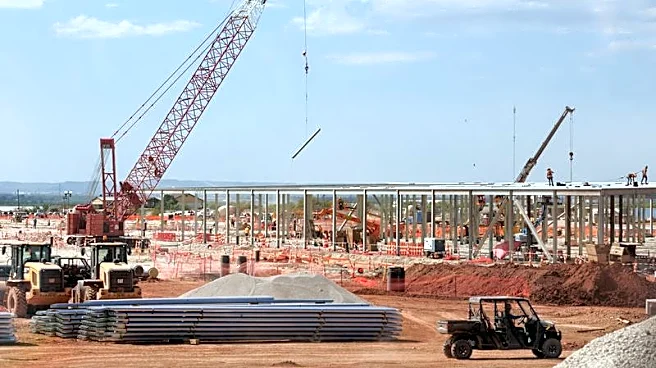
lease with SoftBank affiliate Silver Bands 3 (US) Corp., for research, development, and engineering related to advanced AI compute technologies. The campus, formerly a 3M research facility, is undergoing a significant transformation led by SB Energy, a SoftBank subsidiary. While SB Energy initially presented the site as an office and engineering lab for Graphcore, federal securities filings reveal plans for a much larger data center campus capable of drawing up to 50 megawatts of critical IT capacity. This discrepancy has led to significant pushback from local residents and city officials, who express concerns about the project's scale, power, and water consumption. The first phase of construction is expected to conclude in spring 2027.
Why It's Important?
This development highlights the growing demand for advanced AI compute infrastructure in the U.S. and the challenges associated with its rapid expansion. Graphcore's establishment of a U.S. engineering hub signifies the country's importance in AI innovation and semiconductor development. However, the controversy surrounding the Cosmos Technology Campus underscores a broader national issue: the tension between technological advancement and local community concerns. The project's substantial power and water requirements, potentially drawing enough electricity for 40,000 households and water for nearly 900, raise critical questions about resource allocation and environmental impact. The situation also exposes regulatory gaps, as the campus operates under a legacy 1980s Site Development Agreement, limiting the city's ability to intervene. This case could set a precedent for how future large-scale tech developments are communicated and regulated, particularly in areas with existing infrastructure and residential communities.
What's Next?
The Austin City Council has adopted a resolution directing staff to create a data center zoning category and new regulations to mitigate impacts on local power, water resources, and neighborhoods, with an initial update expected in December. State regulators are also actively reviewing data center projects; Governor Greg Abbott has directed ERCOT and the Public Utility Commission of Texas to audit all data centers seeking grid connections, especially those consuming over 25 megawatts. This audit will examine power and water needs, though it's unclear if it applies to projects already under construction like Cosmos. A community town hall is scheduled for September 17 to address residents' concerns directly. SB Energy claims the project will comply with existing zoning and noise standards, and water usage will not exceed that of the previous tenant, utilizing closed-loop cooling and reclaimed water. Operations at the Cosmos campus are anticipated to begin in spring 2027.
Beyond the Headlines
The situation in Austin reflects a national trend where the rapid growth of data centers, driven by AI and other advanced technologies, is outstripping existing regulatory frameworks and community expectations. The lack of transparency and the perceived misrepresentation of the project's scope have eroded public trust, highlighting the need for clearer communication and more robust engagement between developers, local governments, and residents. This incident could prompt a re-evaluation of how legacy development agreements are applied to modern, high-impact projects. Furthermore, the significant energy and water demands of data centers, even with efficiency measures like closed-loop cooling, will continue to be a critical environmental and infrastructural challenge, potentially leading to more stringent state and local regulations across the U.S. as communities grapple with the trade-offs of technological progress.