



What's Happening?
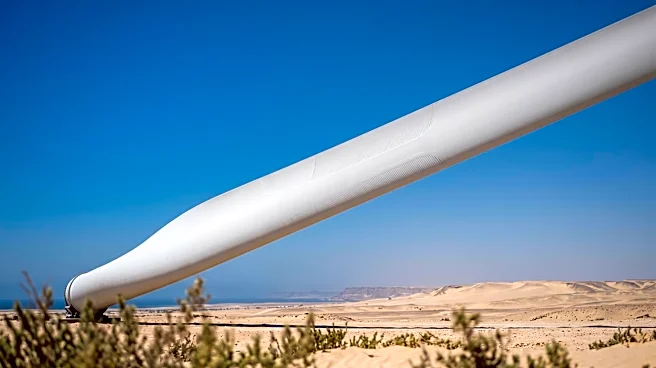
ENGIE and its partners have achieved financial close for the Gulf of Suez 3 wind farm, a 900MW project located near Ras Shokeir in Egypt. This significant development secures approximately $588 million in non-recourse debt. The project involves a 25-year
power purchase agreement with the Egyptian Electricity Transmission Company (EETC), with payment obligations guaranteed by Egypt's Ministry of Finance. The ownership structure of Shokeir Wind Energy, the entity building and operating the farm, includes Aeolus holding 40%, ENGIE as the lead developer with 35%, and Orascom Construction with 25%. The debt financing includes contributions from the Japan Bank for International Cooperation, which is lending up to $285 million, and Nippon Export and Investment Insurance, covering around $190 million of commercial bank loans from various international banks. The wind farm will be connected to the grid in phases, with the first 300MW expected to begin commissioning in January 2028, and the full 900MW in commercial operation by the third quarter of the same year.
Why It's Important?
This project marks a substantial step in Egypt's renewable energy ambitions and has broader implications for the global energy transition. For ENGIE, it represents their largest onshore wind farm worldwide, significantly expanding their renewable energy portfolio. The financial close, backed by international banks and government guarantees, demonstrates confidence in large-scale renewable energy projects in emerging markets. For the U.S., this development highlights the growing global shift towards renewable energy and the potential for international collaboration in financing and developing such projects. It also underscores the increasing role of Middle Eastern and African nations in the global energy landscape, moving towards cleaner energy sources. The success of this project could encourage further foreign investment in renewable energy infrastructure in the region, potentially creating new opportunities for U.S. technology providers and investors in the clean energy sector.
What's Next?
Construction of the Gulf of Suez 3 wind farm will now proceed, with Goldwind responsible for turbine supply and commissioning, and Orascom Construction handling civil and electrical balance of plant works. The phased connection to the grid will see the first 300MW operational by January 2028, followed by the full 900MW by Q3 2028. Once fully operational, the wind farm is projected to generate approximately 4 TWh of electricity annually, significantly contributing to Egypt's energy supply and decarbonization efforts. This project will increase ENGIE's wind capacity in Egypt to about 1.8 GW, solidifying its position in the country's renewable energy market. The successful execution of this project could serve as a blueprint for future large-scale renewable energy developments in the region, attracting more international investment and accelerating the transition away from fossil fuels.
Beyond the Headlines
The Gulf of Suez 3 wind farm project extends beyond its immediate energy generation capacity, symbolizing a broader trend of strategic partnerships and financial innovation in the renewable energy sector. The involvement of multiple international financial institutions and the backing of the Egyptian Ministry of Finance de-risk the project, making it attractive for large-scale investment. This model of blended finance, combining public and private capital with government guarantees, is crucial for mobilizing the vast sums needed for the global energy transition, particularly in developing economies. Furthermore, the project's scale and the long-term power purchase agreement provide a stable framework for renewable energy development, fostering local job creation and technology transfer. It also highlights the critical role of robust regulatory frameworks and government support in attracting and sustaining foreign direct investment in clean energy infrastructure.