






What's Happening?
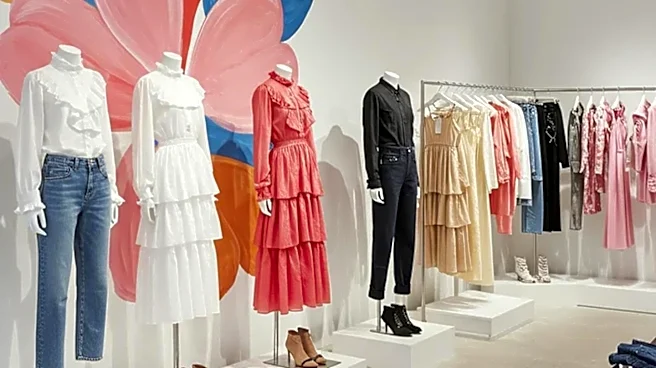
VF Corporation, a global apparel and footwear company, has partnered with SAP to open S.Fashion, a retail innovation space at SAP's headquarters in Walldorf. This initiative aims to explore how AI-enabled, end-to-end processes can enhance consumer experience
and streamline store operations. The store features products from VF Corporation's brands, including The North Face, Vans, and Timberland. S.Fashion integrates item-level RFID data, robotics, and SAP applications to manage inventory, orders, pricing, promotions, and replenishment. AI agents are designed to interpret events and coordinate actions across processes, with human oversight for rules and exceptions. The store allows customers to discover products, use virtual try-on options, and create personalized orders, which then trigger automated processes for item retrieval, customization, packing, payment, and collection. The system updates inventory and can initiate replenishment without manual handoffs between systems. The store will be accessible to SAP employees, their friends and families, and arranged visits for customers and partners.
Why It's Important?
This collaboration between VF Corporation and SAP represents a significant step in the retail industry's adoption of advanced AI and automation technologies. For VF Corporation, it provides a live testing environment to understand what resonates with consumers and how technology can empower store teams to deliver better experiences. The insights gained from S.Fashion could lead to faster learning, focused innovation, and scalable solutions across VF Corporation's diverse brand portfolio. For the broader retail sector, this project demonstrates a potential future where technology reduces operational complexity, allowing staff to focus more on customer engagement. The integration of AI across various retail functions, from inventory management to personalized customer interactions, could set new benchmarks for efficiency and customer satisfaction, potentially influencing how other U.S. retailers approach digital transformation and in-store experiences.
What's Next?
S.Fashion will function as a live test environment, allowing VF Corporation and SAP to gather real-world data on the effectiveness of AI and automation in a retail setting. The project aims to identify what works and what doesn't, providing valuable insights for future technological deployments. While S.Fashion is not a full-scale rollout across VF Corporation's retail network, the learnings from this innovation space are expected to inform the company's broader strategy for integrating AI into its operations. The store will also operate autonomously during selected hours, testing the extent to which a retail environment can function without on-site staff. This experiment could pave the way for more autonomous retail models, potentially impacting staffing needs and operational costs in the long term. The project's success in streamlining processes and enhancing customer experience will likely influence investment decisions in similar technologies across the U.S. retail landscape.
Beyond the Headlines
The S.Fashion project highlights a deeper shift in the retail paradigm, moving beyond simply adding digital experiences to physical stores towards creating a fully integrated, AI-driven ecosystem. The emphasis on connecting back-end processes like inventory and replenishment with front-end customer interactions underscores the importance of data consistency and seamless information flow. This initiative suggests that the next wave of retail innovation will focus not just on flashy customer-facing technologies, but on the less visible, painstaking work of making product information consistent and actionable across the entire supply chain. The ethical implications of autonomous stores, particularly concerning employment and the role of human interaction in retail, will also be a critical area of discussion as such models evolve. This project could trigger a re-evaluation of the balance between technological efficiency and the human element in retail, potentially leading to new industry standards for employee training and customer service in an increasingly automated world.