






What's Happening?
China has unveiled ambitious goals to advance its logistics network by 2030, aiming to improve connectivity and bolster the real economy. A plan released by the National Development and Reform Commission (NDRC) and the Ministry of Transport outlines these
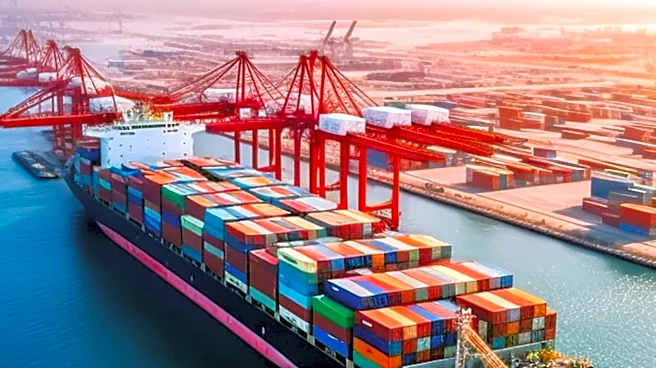
objectives. By 2030, China expects significant progress in its logistics network, including closer coordination between logistics hubs and industries, enhanced internal and external connectivity, and the adoption of greener and smarter facilities and equipment. The plan also emphasizes greater interoperability of rules and information within the logistics sector. This initiative is projected to effectively reduce total social logistics costs to 13.1 percent of GDP by 2030, a decrease of 0.8 percentage points from the end of 2025. This reduction is intended to improve the efficiency and performance of the real economy, facilitating smoother economic circulation and high-quality development. The plan details 17 key tasks across seven areas, such as developing and connecting logistics hubs, enhancing logistics corridor capacity, addressing deficiencies in urban and rural logistics facilities, and promoting digitalization, smart development, and green transformation of logistics infrastructure.
Why It's Important?
China's strategic focus on optimizing its logistics network by 2030 has significant implications for global trade and U.S. industries. A more efficient and cost-effective logistics system in China could further enhance its competitiveness as a manufacturing and export hub, potentially impacting global supply chains and trade dynamics. For U.S. businesses that rely on Chinese manufacturing or engage in trade with China, improved logistics could mean faster delivery times and reduced shipping costs, but also intensified competition from Chinese goods in international markets. The emphasis on greener and smarter facilities aligns with global trends towards sustainability and technological integration, which could influence U.S. companies to adopt similar practices to remain competitive. Furthermore, the plan's goal to reduce logistics costs as a percentage of GDP highlights a concerted effort to boost the efficiency of China's real economy, which could lead to more robust economic growth and increased demand for raw materials and components, some of which may be supplied by U.S. firms. Conversely, U.S. logistics and transportation companies might face increased pressure to innovate and optimize their own operations to match the efficiency gains seen in China.
What's Next?
The logistics network is one of six key networks prioritized during China's 15th Five-Year Plan period (2026-2030), alongside water networks, new-type power grids, computing power networks, next-generation communication networks, and urban underground pipeline networks. The NDRC views these six networks as an integrated system designed for deep interconnection, mutual empowerment, and coordinated support. Preliminary estimates suggest that investment in these six networks and other key areas will exceed 7 trillion yuan (approximately 1.03 trillion U.S. dollars) this year. This substantial investment indicates a sustained commitment to infrastructure development and technological upgrades across multiple sectors. Moving forward, U.S. businesses and policymakers should anticipate continued advancements in China's infrastructure, which will likely further integrate its domestic economy and enhance its global trade capabilities. This could lead to new opportunities for U.S. companies in areas like smart logistics technology, green energy solutions, and advanced computing, but also increased competition in traditional manufacturing and logistics sectors. The coordinated development of these networks suggests a holistic approach to national development, aiming for synergistic benefits across different economic pillars.
Beyond the Headlines
The comprehensive development of China's logistics network, as part of a broader strategy encompassing five other critical networks, signifies a deeper commitment to national economic resilience and strategic autonomy. This integrated approach aims not only to improve efficiency but also to create a more self-sufficient and technologically advanced economy. The focus on 'greener' facilities and 'smarter' equipment reflects a dual objective of sustainable development and technological leadership, potentially setting new benchmarks for global logistics. For the U.S., this long-term vision from China could necessitate a re-evaluation of its own infrastructure investment strategies and technological development priorities to maintain global competitiveness. The interoperability of rules and information within China's logistics system could also lead to the establishment of new international standards, potentially challenging existing U.S.-led frameworks. Furthermore, the massive investment in these networks could accelerate China's industrial upgrading, moving it further up the value chain and reducing its reliance on foreign technologies and components, which has long-term implications for global trade balances and geopolitical influence. The ethical dimension of such extensive data integration within a national logistics system, particularly concerning data privacy and control, also warrants careful consideration.