




What's Happening?
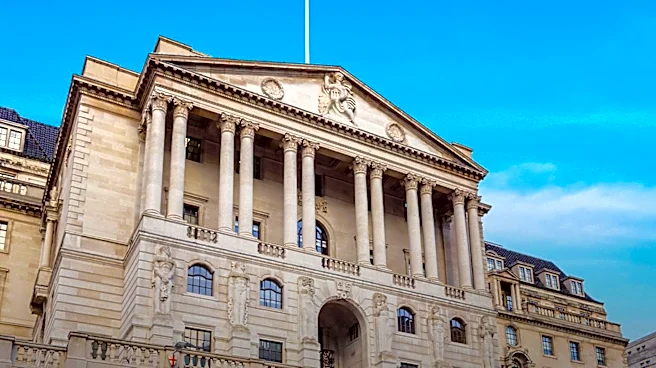
The Bank of England recently increased its base rate by 0.25 percentage points to 4%, marking the first hike since August 2023. This decision aims to counter rising inflation, which the Bank forecasts to reach 4.5% in the first quarter of 2027 and 5% in the second
quarter. Inflation hit 3.5% in September, with fuel inflation jumping 29.8%. Bond managers, such as Mike Riddell of Fidelity Strategic Bond, anticipate further rate increases, possibly several, to combat what they see as a continuing upward trajectory of inflation. The Bank's governor, Andrew Bailey, has stated that interest rate decisions are not on a 'pre-set path' and will be contingent on economic developments. The conflict in the Middle East is cited as a factor pushing up global energy prices, contributing to concerns that higher costs will sustain elevated inflation.
Why It's Important?
The Bank of England's decision to raise interest rates and the expectation of further hikes have significant implications for households and the broader economy. Higher interest rates directly impact borrowing costs, making mortgages and other forms of credit more expensive. This, combined with rising inflation, creates a 'dual squeeze' on household finances, reducing disposable income and spending power. Interest-rate-sensitive sectors, such as the housing market, are already experiencing tension. While UK GDP growth has remained resilient, largely driven by tech-related industries, the impact on consumer-facing businesses like restaurants and retailers, which rely on discretionary spending, could be negative. The Bank's strategy aims to curb inflation, but there's a concern that it might suppress demand in the economy, especially if inflation is primarily supply-driven rather than demand-driven.
What's Next?
Financial markets are pricing in a significant possibility of another interest rate increase by the Bank of England's Monetary Policy Committee (MPC) at its next meeting, with some traders putting the probability at around 74%. Mortgage borrowers, particularly those on tracker mortgages or approaching the end of fixed-rate deals, face immediate or impending increases in repayments. Experts advise borrowers to review their options well in advance and maintain a sensible cash buffer. Savers are encouraged to spread their cash between flexible and fixed-rate deals to secure returns that can beat inflation. The Bank will continue to assess economic data, including inflation figures and global energy market volatility, before making further decisions. The ongoing conflict in the Middle East is a key factor that could influence future rate adjustments.
Beyond the Headlines
The current economic situation highlights a complex challenge for central banks: distinguishing between demand-driven and supply-driven inflation. While higher interest rates are effective against excessive demand, they are less potent against inflation caused by supply shocks, such as rising energy prices due to geopolitical conflicts. The risk is that aggressive rate hikes could stifle economic growth and household spending without fully addressing the root causes of inflation. This could lead to a scenario where domestic demand is crushed, impacting businesses and employment, while inflation remains elevated due to external factors. The long-term implications could include a shift in consumer behavior towards greater financial prudence and a re-evaluation of investment strategies to hedge against persistent inflation.