







What's Happening?
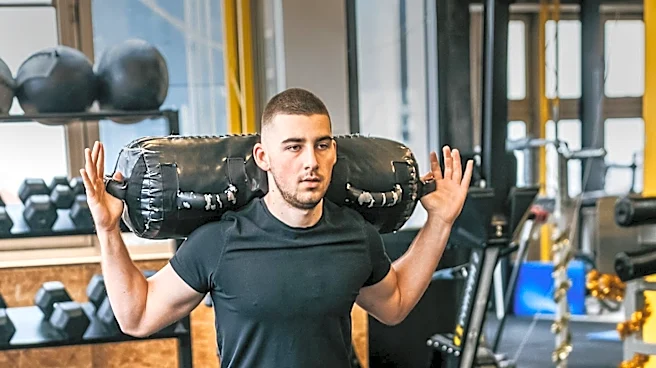
Rucking, the practice of walking with a weighted backpack, is identified as an effective exercise for maintaining fitness, particularly for tactical athletes. It is often paired with bodyweight exercises to compensate for the under-loading of legs in calisthenics.
For general resistance training, the optimal number of exercises per muscle group per session is typically 2 to 4, with a weekly total of 10 to 20 hard sets for hypertrophy. However, for tactical athletes who also engage in running and rucking, the focus shifts to the minimum effective volume, usually 1 to 2 exercises per muscle per session, prioritizing heavy compound lifts. This approach aims to balance strength gains with the recovery demands of endurance training, as excessive volume can interfere with overall performance.
Why It's Important?
This information is crucial for individuals seeking to optimize their fitness routines, especially those with demanding physical requirements like tactical athletes. Understanding the dose-response relationship between training volume and muscle growth, as well as the potential interference effect between strength and endurance training, allows for more efficient and effective program design. For the general public, it provides guidance on how to structure workouts for hypertrophy or strength, emphasizing that weekly hard sets are more critical than the sheer number of exercises. For military personnel and first responders, this tailored approach ensures they can maintain the necessary strength and endurance without overtraining, which is vital for occupational performance and injury prevention.
What's Next?
Individuals can apply these principles to refine their current training programs. Tactical athletes, in particular, should consider adjusting their resistance training volume to align with their endurance demands, focusing on intensity over excessive volume. Fitness professionals and coaches can use this research-backed guidance to develop more effective and personalized training plans for their clients, especially those involved in concurrent training. Further research may explore more nuanced interactions between different types of exercise and individual recovery capacities, leading to even more precise training recommendations in the future. The continued emphasis on functional strength and endurance will likely shape future fitness trends and program development.
Beyond the Headlines
The discussion on optimizing exercise volume and managing the interference effect between strength and endurance training highlights a broader shift in fitness philosophy towards more intelligent and individualized programming. Instead of simply 'more is better,' the focus is now on 'optimal is better,' considering an individual's specific goals, recovery capacity, and concurrent activities. This approach has implications for public health, promoting sustainable exercise habits that reduce the risk of overtraining and injury. It also underscores the importance of evidence-based practices in the fitness industry, moving away from anecdotal advice towards scientifically supported methodologies. The integration of rucking into comprehensive fitness plans reflects a growing appreciation for practical, real-world applicable forms of exercise.