




What's Happening?
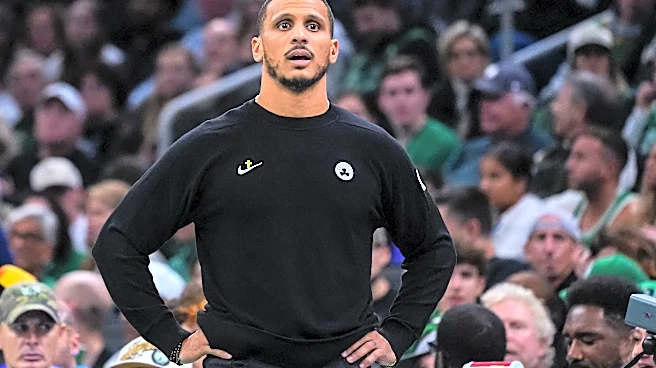
Joe Mazzulla, the head coach of the Boston Celtics, has revealed his daily use of an AI assistant named Claude, developed by Anthropic, to enhance his coaching methods. Mazzulla stated he is fully committed to using AI in his work, not for making real-time
game decisions like player lineups or plays, but to critically evaluate and improve his established coaching processes. He utilized these tools extensively during the summer to analyze various aspects of team preparation, including practice organization, film analysis, and communication strategies with athletes. For instance, he uses AI to assess the efficiency of past season's training programs and to synthesize data for deeper psychological insights into player management. Mazzulla also explores interdisciplinary connections, asking AI to identify shared tactical principles between basketball, soccer, and handball that could be applied to five-on-five basketball scenarios.
Why It's Important?
Mazzulla's adoption of AI signifies a growing trend of advanced technology integration in professional sports, potentially setting a new standard for coaching methodologies in the NBA and beyond. By using AI to question and refine existing habits and rituals, coaches can move towards more scientifically backed and efficient approaches to team management and player development. This could lead to optimized training schedules, more effective film review sessions, and improved communication strategies, ultimately enhancing team performance. The exploration of interdisciplinary tactics through AI also highlights a shift towards innovative strategic thinking, potentially uncovering novel game approaches that traditional analysis might miss. This could give teams leveraging such technology a competitive edge, influencing how other sports organizations invest in and utilize AI for performance optimization.
What's Next?
The successful implementation of AI by Coach Mazzulla could prompt other NBA teams and professional sports organizations to explore similar technological integrations. As AI tools become more sophisticated, their application in sports is likely to expand beyond analytical support to potentially include real-time strategic adjustments, personalized player development plans, and advanced injury prevention. The ongoing success of the Celtics under Mazzulla's AI-enhanced coaching could serve as a case study, encouraging broader adoption and investment in AI within the sports industry. This could lead to a new era of data-driven coaching, where traditional coaching instincts are augmented by advanced computational analysis, pushing the boundaries of athletic performance and strategic innovation.
Beyond the Headlines
Mazzulla's use of AI raises broader questions about the evolving role of human expertise in fields increasingly influenced by artificial intelligence. While he emphasizes AI as a tool for questioning and refining, rather than replacing, human decision-making, it highlights a shift in how professionals might leverage technology to enhance their cognitive processes. This development could spark discussions about the ethical implications of AI in sports, such as data privacy for athletes and the potential for algorithmic bias in performance evaluations. Furthermore, it underscores a cultural shift where even highly intuitive and experience-driven professions like sports coaching are embracing advanced technological assistance, suggesting a future where human-AI collaboration becomes a cornerstone of success across diverse industries.