




What's Happening?
The Trump administration has announced new import duties targeting 14 economies, including China, Japan, and the European Union, citing concerns over excess manufacturing capacity. U.S. Trade Representative Jamieson Greer stated that a monthslong Section
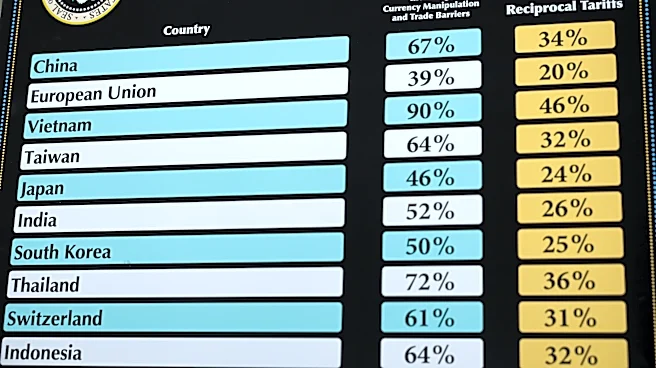
301 probe concluded that these economies' practices regarding excess capacity and production are 'unreasonable and burden or restrict U.S. commerce.' These tariffs, expected to take effect early next year, aim to reinstate duties after a Supreme Court ruling in February struck down many of President Trump’s previous tariffs. China faces a 20% tariff, which could double to 40% if the U.S. deems its engagement insufficient. Japan could see tariffs up to 15%, Singapore up to 20%, Vietnam up to 35%, and the European Union a potential 15%. Many of the targeted nations, including China, Japan, Singapore, Malaysia, and the EU, have protested the tariffs and rejected the premise of having excess capacity that distorts global markets. Thailand, however, found its proposed 18% tariff cap more favorable than anticipated.
Why It's Important?
These new tariffs signal a continued aggressive stance by the U.S. on international trade, potentially escalating trade tensions with major global economic partners. The targeted economies collectively represent approximately half of the global economy, meaning these tariffs could have widespread implications for international trade flows and supply chains. For U.S. consumers, economists like Stephen Brown of Capital Economics suggest that while these tariffs largely replace existing ones, they could still contribute to higher prices and keep core goods inflation firm into the next year. The move also highlights the ongoing debate about fair trade practices and industrial policies, with the U.S. asserting that other nations' manufacturing capacities unfairly disadvantage American businesses. The reactions from affected countries, ranging from strong protests to continued engagement, indicate a complex diplomatic and economic landscape ahead, with potential for retaliatory measures or prolonged negotiations.
What's Next?
The new tariffs are slated to take effect early next year, which will likely trigger further responses from the affected economies. China has already stated it will take 'necessary measures to defend its legitimate rights and interests,' suggesting potential retaliatory actions if the tariffs are implemented. The U.S. and China have extended a trade truce by two months, set to expire on January 10, 2027, which could provide a window for further negotiations or de-escalation. Countries like Thailand and Vietnam have expressed intentions to continue negotiations with the U.S. to secure more favorable tariff levels or exemptions. The European Union and Japan have also conveyed their positions to the U.S., indicating ongoing diplomatic efforts. The situation will likely involve continued bilateral and multilateral discussions as nations seek to mitigate the economic impact of these new trade barriers and protect their export markets.
Beyond the Headlines
The Trump administration's justification for these tariffs, centered on 'excess capacity,' delves into a fundamental aspect of global economic competition and industrial policy. The U.S. argument implies that certain nations are engaging in practices that lead to overproduction, thereby distorting global markets and harming U.S. industries. This raises broader questions about the role of government subsidies, state-owned enterprises, and industrial planning in international trade. The pushback from countries like China, which calls the 'overcapacity' notion a 'false premise,' underscores a deep ideological divide on economic models. This development could also accelerate efforts by companies to diversify their supply chains away from heavily tariffed regions, potentially leading to shifts in global manufacturing hubs. Furthermore, the tariffs could reignite debates within the World Trade Organization (WTO) regarding permissible trade remedies and the interpretation of fair trade rules, even as the U.S. has often bypassed WTO mechanisms in its recent trade actions.