




What's Happening?
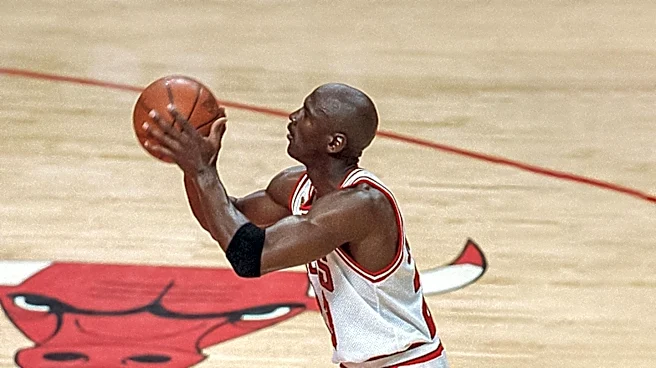
Michael Jordan's ability to secure three consecutive NBA championships from 1996-1998 was largely attributed to a significant evolution in his playing style, as detailed in Kirk Goldsberry's book 'Atlas of Basketball: How the NBA Changed'. After a hiatus
to play baseball, Jordan returned to the NBA as a transformed player. While still athletic, his most potent offensive weapon became the fadeaway jump shot, a move he perfected to an unprecedented degree. This shot, which Jordan himself dubbed the 'wiper' due to its resemblance to windshield wipers, involved him posting up with his back to the basket, faking a move in one direction, then spinning to face the hoop and releasing a fadeaway shot. This technique allowed him to consistently score against the league's best defenders, even when they knew what was coming. In the 1996-97 season, Jordan led the league in successful mid-range shots with 588, significantly more than the second-place player, Mitch Richmond, who had 389. He also ranked third in efficiency among players with at least 400 mid-range attempts, hitting 48.9% of his over 1200 shots.
Why It's Important?
This transformation in Michael Jordan's game is crucial because it demonstrated a new pathway to success for perimeter players in the NBA, influencing the sport's future trajectory. By mastering the fadeaway jump shot, Jordan proved that guards could dominate scoring and lead teams to championships by creating their own shots from the mid-range, even against intense defensive pressure. This challenged conventional coaching wisdom of the era, which often discouraged shots taken while moving away from the basket. His success with the 'wiper' shot laid the groundwork for future generations of players who rely on jump shooting, such as Stephen Curry, to achieve league-leading scoring titles and NBA championships. Jordan's ability to adapt and refine his game, turning a perceived weakness into an unstoppable strength, highlights the importance of continuous skill development and strategic evolution in professional sports. His dominance in one-on-one matchups, even when opponents knew his intentions, underscored his unparalleled skill and mental fortitude.
Beyond the Headlines
The evolution of Michael Jordan's game, particularly his mastery of the 'wiper' shot, offers deeper insights into the strategic and psychological aspects of professional basketball. His ability to consistently execute a move that every opponent anticipated speaks to a level of skill and mental toughness that transcends mere athleticism. This development also reflects a broader shift in how individual talent can dictate team strategy; as coach Phil Jackson noted, the Bulls could simplify their offense by simply giving the ball to Jordan in the mid-range. Furthermore, Jordan's transformation from an aerial, rim-attacking player to a mid-range specialist illustrates the longevity and adaptability required for sustained greatness in sports. His impact extended beyond his own performance, as he effectively mapped out a future for the sport where guards could be primary scoring threats through sophisticated jump shooting, a concept that continues to shape offensive strategies in the modern NBA.