




What's Happening?
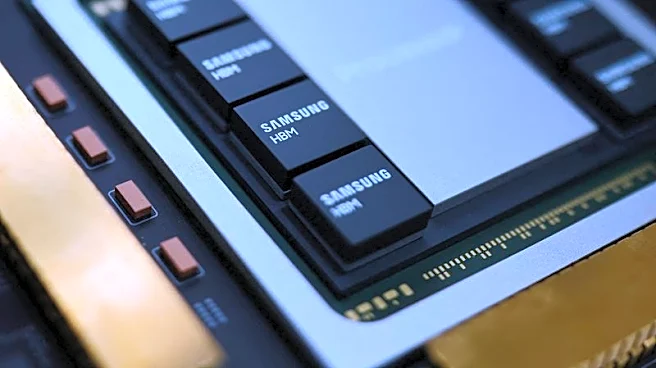
The artificial intelligence (AI) memory landscape is undergoing a significant transformation, moving beyond its previous reliance on High Bandwidth Memory (HBM). Industry analysts indicate that the future AI memory architecture will feature a more diversified
approach, incorporating SRAM, HBM, DDR/LPDDR, CXL, and NAND technologies, each serving distinct functions. This shift is driven by the increasing demand for AI accelerators like Cerebras and Groq, which are heavily integrating SRAM, and the rapid expansion of Long Context and KV Cache requirements. Taiwanese manufacturers, including Winbond Electronics and Nanya Technology, are poised to capitalize on this structural change, expanding their AI growth opportunities from DRAM and niche memory products to NAND solutions.
Why It's Important?
This diversification in AI memory architecture is crucial for the technology industry, as it broadens the competitive landscape and creates new revenue streams for various memory manufacturers. Previously, HBM held a near-monopoly in high-performance AI applications, but the emergence of new AI workloads and accelerator designs necessitates a more varied memory ecosystem. This shift means that companies specializing in SRAM, DDR, and NAND, which were not primary beneficiaries of the initial HBM boom, now have significant opportunities. For U.S. tech companies, this could lead to more robust supply chains, reduced reliance on a single memory technology, and potentially lower costs for AI hardware development. It also encourages innovation across different memory types, fostering a more dynamic and resilient AI infrastructure.
What's Next?
In the short term, HBM is expected to maintain its core position in AI training and high-throughput inference, with limited impact from SRAM until 2026-2027. However, the period after 2028 is identified as a critical juncture where SRAM architectures are projected to increasingly take over new AI inference workloads, particularly those involving Feedforward Networks (FFN). Winbond Electronics, with its diverse portfolio including niche DRAM and SLC NAND, is well-positioned to benefit from the expanding DRAM demand driven by AI servers and the extension of AI memory hierarchies to Flash. Nanya Technology is also expected to see growth as DDR5 adoption increases and its customized AI UWIO memory solutions contribute to revenue. The market will closely watch how these companies adapt and expand their offerings to meet the evolving demands of the AI memory market.
Beyond the Headlines
The evolving AI memory landscape, with its diversification beyond HBM, signifies a deeper trend in technological development: the constant need for specialized solutions to meet increasingly complex demands. This isn't merely a technical shift; it reflects the growing maturity of the AI industry, where different types of memory are optimized for specific AI tasks, from large-scale model training (HBM) to low-latency inference (SRAM) and data storage (NAND). This specialization could lead to a more fragmented but ultimately more efficient and powerful AI ecosystem. Ethically, it raises questions about potential vendor lock-in and the need for open standards to ensure interoperability and prevent market dominance by a few players. Culturally, it highlights the rapid pace of innovation in the tech sector, where today's cutting-edge solution can quickly become one of many, pushing companies to continuously adapt and innovate to stay relevant in the AI race.