


What's Happening?
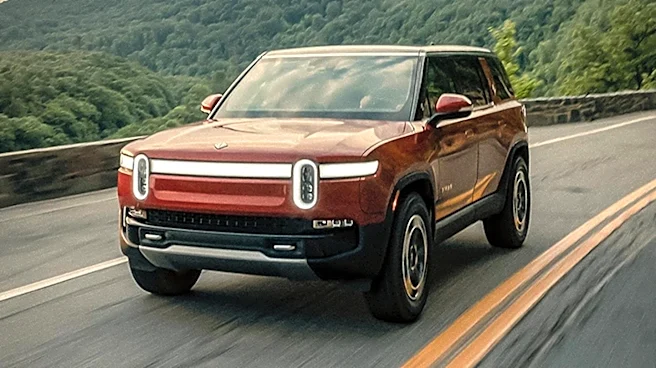
Rivian, once touted as a potential rival to Tesla, has seen its stock price fall about 80% below its IPO price. The company initially produced three electric vehicles: the R1T pickup, R1S SUV, and custom delivery vans for Amazon. In March, Rivian launched
its R2 SUV, its cheapest vehicle, to expand its market reach. However, production slowed in 2024 and 2025 due to supply chain constraints and reduced EV subsidies. Despite these challenges, Rivian expects its annual deliveries to rise significantly by 2026, driven by the R2 model. Analysts predict a 43% compound annual growth rate in revenue from 2025 to 2028, with positive EBITDA expected in the final year.
Why It's Important?
Rivian's situation underscores the difficulties new entrants face in the electric vehicle market, particularly in achieving the scale and efficiency that Tesla has. The company's ability to ramp up production and manage costs will be critical to its success. Rivian's performance will also impact investor confidence in the broader EV sector, as it highlights the challenges of competing in a crowded market with established players. The company's future growth will depend on its ability to leverage its R2 model to capture market share and improve financial performance.
What's Next?
Rivian will need to focus on increasing production efficiency and expanding its market presence to achieve its growth targets. The company may explore strategic partnerships and cost-cutting measures to enhance its competitiveness. Investors will be watching for signs of improved financial performance and market traction, particularly with the R2 model. Rivian's ability to navigate these challenges will determine its long-term prospects in the EV industry.