




What's Happening?
Dutch lawmakers are urging their government to oppose new U.S.-backed restrictions on chip exports to China. This comes as the U.S. Congress considers attaching the MATCH Act to its annual defense bill, which would pressure the Netherlands and Japan to adopt
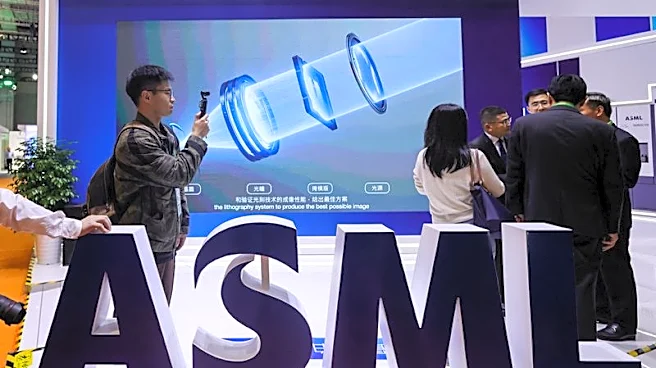
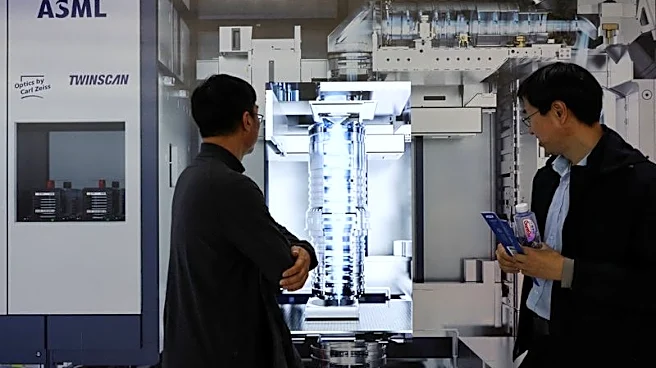
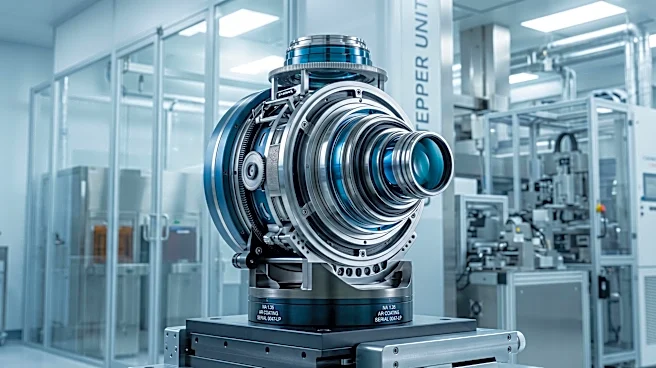
stricter export controls. If these countries do not comply, Washington could impose its own restrictions on their equipment, including ASML's immersion DUV tools. ASML, a critical supplier to the semiconductor industry, anticipates China will account for approximately 20% of its 2026 sales, translating to roughly €9 billion out of a projected €44 billion to €45 billion in total sales. The company has never shipped its advanced EUV systems to China, making DUV tools the primary focus of potential restrictions. Concerns are rising among some Dutch politicians, with Nicole Maes of the conservative VVD party stating that the MATCH Act would be 'disastrous for ASML, and therefore also for the Dutch economy.'
Why It's Important?
The potential U.S. imposition of stricter chip export controls on China, particularly through the MATCH Act, carries significant implications for the global semiconductor industry and the U.S. economy. ASML is a pivotal player, providing essential lithography systems for advanced semiconductor manufacturing. Restricting ASML's sales to China could disrupt the supply chain for numerous technology products, potentially leading to higher costs and slower innovation. For the U.S., while the intent is to curb China's technological advancement, it risks alienating key allies like the Netherlands and Japan, who are vital partners in the semiconductor ecosystem. The Dutch economy, heavily reliant on high-tech exports, stands to lose substantial revenue if ASML's access to the Chinese market is curtailed. This situation highlights the delicate balance between national security interests and economic interdependence in a globalized world, with potential ripple effects on U.S. tech companies that rely on a stable and efficient semiconductor supply.
What's Next?
The immediate next step involves the U.S. Congress's decision on whether to include the MATCH Act in the final annual defense bill. Following this, Foreign Minister Tom Berendsen is expected to discuss the bill during an upcoming visit to China. ASML's fourth-quarter report, anticipated in late January, will be closely watched for management's updated perspective on China's role in its 2027 sales projections. The company is also actively exploring ways to increase its 2028 capacity beyond the 30% increase previously flagged, as demand continues to outstrip supply, driven largely by AI spending. The outcome of these legislative and diplomatic efforts will determine the extent of future export controls and their impact on ASML's operations and the broader semiconductor market.
Beyond the Headlines
The debate surrounding the MATCH Act and its potential impact on ASML extends beyond immediate economic concerns, touching upon deeper geopolitical and ethical considerations. It underscores the increasing weaponization of technology and trade in international relations, where access to critical components like advanced semiconductors becomes a tool for strategic competition. This approach could accelerate China's efforts to achieve self-sufficiency in chip manufacturing, potentially leading to a more fragmented global technology landscape. Furthermore, it raises questions about national sovereignty and the extent to which one nation can dictate the trade policies of its allies. The long-term implications could include a re-evaluation of global supply chain dependencies, increased investment in domestic manufacturing capabilities across various countries, and a potential shift in technological leadership, all of which could have profound and lasting effects on the U.S.'s economic and strategic standing.