







What's Happening?
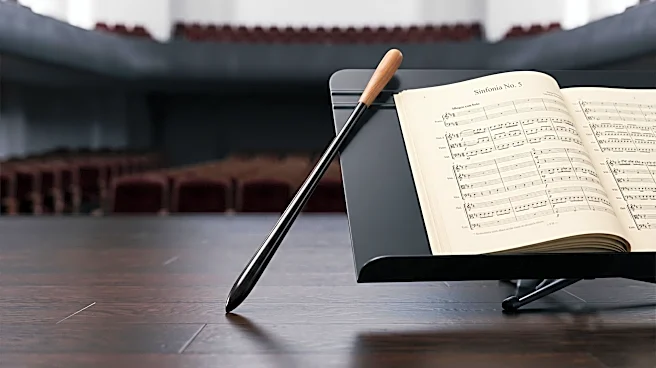
Gustavo Dudamel has arrived in New York as the new Philharmonic director, bringing with him a mission to democratize classical music and extend its impact beyond the concert hall. Known as 'The Dude' during his 17-season tenure with the Los Angeles Philharmonic,
Dudamel previously broadened the orchestra's reach through educational programs and popular culture crossovers. His inaugural concert at David Geffen Hall was a star-studded event, signaling a new era for the New York Philharmonic. Dudamel's approach is deeply influenced by his upbringing in Venezuela, where he learned violin through El Sistema, a program that provides free music education to children from low-income families. He views music as a 'fundamental right' and aims to make people feel they belong in the world of classical music. His arrival has generated significant buzz among the city's cultural elite and those involved in music education.
Why It's Important?
Dudamel's arrival in New York and his commitment to music education are significant for several reasons. His philosophy, rooted in El Sistema, emphasizes music as a tool for social transformation, particularly for underserved communities. This approach challenges the perception of classical music as an elitist art form and seeks to make it accessible to a broader audience. His influence could lead to increased funding and attention for music education programs in New York City and across the U.S., many of which are already inspired by the El Sistema model. The $40 million donation from Oscar L. Tang and Agnes Hsu-Tang to advance music education and bring orchestra to new audiences, following Dudamel's appointment, underscores the potential for substantial investment in these initiatives. This focus on community engagement and accessibility could help diversify the audience for classical music and foster a new generation of musicians and enthusiasts, addressing long-standing issues of segregation and 'arts deserts' in urban areas.
What's Next?
Dudamel's tenure is expected to bring a renewed focus on community engagement and music education within the New York Philharmonic. While he will be with the orchestra for approximately 15 weeks a year, his vision is anticipated to drive long-term changes. Programs like UpBeat NYC, which offers free music education in the South Bronx, hope that Dudamel's presence will bring more attention and resources to their efforts. The Philharmonic's Vice President for Education and Community Engagement, Gary Padmore, indicated that his team will target 'arts deserts' in the city, such as Corona in Queens and Canarsie in Brooklyn. The initial period will involve 'deep listening' to understand the community's needs. The success of these initiatives will depend on sustained funding, community partnerships, and the ability to overcome systemic challenges like school segregation and the need for greater diversity within classical music institutions.
Beyond the Headlines
Beyond the immediate impact on music education and audience engagement, Dudamel's mission touches upon deeper societal issues. His belief that music is a 'fundamental right' challenges the commodification of art and advocates for its role in human development and social equity. The inspiration drawn from El Sistema, despite its complex history with Venezuelan political regimes, highlights the potential of music to transcend political divides and foster community. The discussion around diversifying the orchestra and addressing the historical displacement of communities for cultural institutions like Lincoln Center, as noted by Richard Miller of UpBeat, points to the ongoing need for cultural institutions to confront their past and actively work towards inclusivity. Dudamel's leadership could serve as a catalyst for broader conversations about access, equity, and the transformative power of the arts in American society, encouraging a re-evaluation of how cultural resources are distributed and utilized.