







What's Happening?
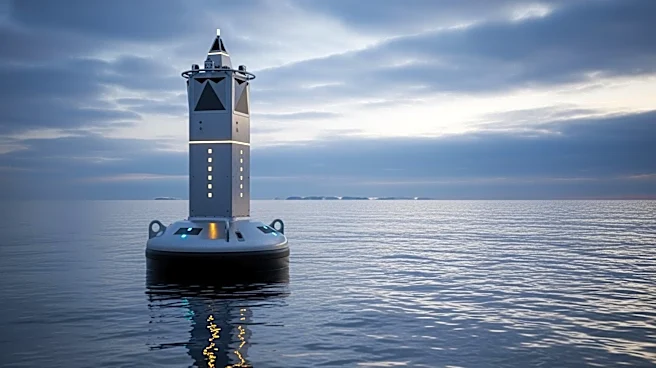
Bilfinger and Schneider Electric have successfully completed a pilot project involving an autonomous offshore buoy in the North Sea. This buoy, developed for Buoyant Production Technologies, a subsidiary of Crondall Energy, has operated autonomously for 1,000
hours since its deployment in late 2025. The project aims to demonstrate a new method of powering and controlling remote subsea assets without the need for permanent offshore personnel or traditional umbilical connections. The buoy is equipped with a renewable energy microgrid that integrates wind, solar, battery storage, and backup diesel generation, allowing it to manage local subsea controls independently. This innovative approach is designed to reduce development costs for remote offshore assets by up to 50%, while also lowering emissions and simplifying field infrastructure.
Why It's Important?
The successful deployment of the autonomous buoy represents a significant advancement in offshore energy technology. By eliminating the need for traditional infrastructure, such as permanent personnel and umbilical connections, the project offers a cost-effective and environmentally friendly solution for managing remote offshore assets. This could lead to substantial savings for the energy industry, particularly in the development of marginal offshore fields. Additionally, the use of renewable energy sources aligns with global efforts to reduce carbon emissions and transition to more sustainable energy practices. The project also highlights the potential for software-defined automation to revolutionize offshore operations, offering new models for production and subsea developments.
What's Next?
Following the successful pilot, there is potential for this technology to be replicated and scaled across future offshore assets. The companies involved, Bilfinger and Schneider Electric, see this as an opportunity to further decarbonize industries that are traditionally hard to abate. The next steps may involve expanding the use of this technology to other regions and projects, potentially transforming the way offshore energy is produced and managed. Stakeholders in the energy sector, including operators and investors, may closely monitor the outcomes of this pilot as they consider adopting similar technologies for their operations.