






What's Happening?
GXO Logistics plans to significantly increase its deployment of adaptive technologies across its U.S. operations in 2027. This phased rollout will begin at GXO's priority sites and continue over a 12-month period. The technologies to be deployed include
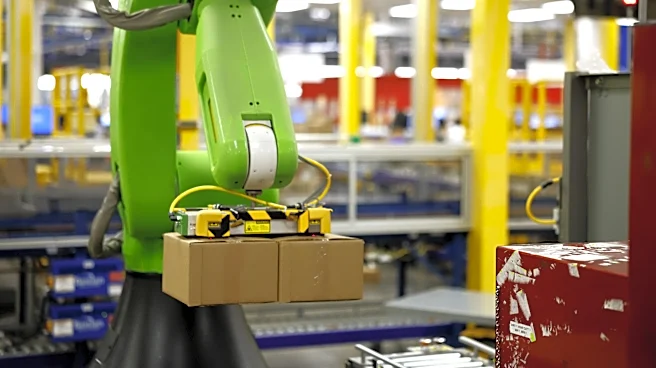
Pallet Autonomous Mobile Robots (AMRs) for automating material transport, robotic arms for various applications like inbound unloading and packing, AI-enabled vision technologies for hands-free data capture and improved inventory checks, and flexible, scalable automated sortation systems. According to Michael Jacobs, CEO of the Americas & Asia Pacific at GXO, these deployments are aimed at enhancing efficiency, optimizing labor resources, and improving service levels for customers. GXO has also expanded its partnerships with humanoid robot developers. The company is working with Apptronik towards a global rollout of up to 1,000 Apollo humanoids over the next four years, with trials showing Apollo performing logistics tasks like kitting with 96% efficiency compared to human benchmarks. Additionally, GXO plans to deploy Agility Robotics' Digit humanoids in its North Carolina and Tennessee sites, following a successful deployment in Flowery Branch, Ga., where Digit moved over 100,000 totes since late 2023. GXO is also testing Reflex from Reflex Robotics.
Why It's Important?
GXO Logistics' accelerated investment in robotics and automation signals a major trend in the U.S. logistics and supply chain industry. This move is crucial for addressing persistent challenges such as labor shortages, increasing demand for faster delivery, and the need for greater operational efficiency. By deploying a diverse range of technologies, including AMRs, robotic arms, and AI-enabled vision systems, GXO aims to create more resilient and responsive supply chains. The expansion of humanoid robot deployments, despite previous acknowledgments from GXO CEO Patrick Kelleher that humanoids had not yet produced a return on investment (ROI), indicates a long-term strategic commitment to these advanced systems. If successful, these deployments could set new industry standards for automation, potentially influencing other logistics providers to follow suit. The focus on proving KPIs and achieving ROI with humanoids suggests a maturing phase for this technology, moving from experimental to practical application. This could lead to significant cost savings, improved safety, and enhanced productivity across GXO's extensive network, ultimately benefiting consumers through more efficient product delivery.
What's Next?
GXO's phased rollout of adaptive technologies across its U.S. priority sites will commence in 2027 and continue for 12 months. The company will expand joint trials of Apptronik's Apollo humanoids in live operations for various warehouse workflows, including picking, case and tote movement, packing, and sortation, as part of a plan for a global rollout of up to 1,000 units over the next four years. Deployments of Agility Robotics' Digit humanoids are also planned for GXO's North Carolina and Tennessee sites. GXO will continue to evaluate the performance and ROI of these advanced robotic systems. The company's ongoing efforts to integrate these technologies will likely involve continuous assessment of their impact on efficiency, labor optimization, and service levels. The success of these deployments could influence future investment decisions and the broader adoption of robotics in the logistics sector, potentially leading to further partnerships and technological advancements.
Beyond the Headlines
The aggressive adoption of robotics by a major logistics player like GXO has broader implications for the U.S. workforce and the future of labor. While GXO emphasizes optimizing labor resources, the increased automation could lead to a shift in job roles, requiring new skills for managing and maintaining robotic systems. This necessitates a focus on workforce retraining and education to prepare for an evolving job market. Furthermore, the integration of AI-enabled vision technologies and advanced robotics raises questions about data privacy and security within warehouse environments. The push for efficiency and automation also highlights the competitive pressures within the logistics industry, where companies are constantly seeking innovative solutions to gain an edge. The long-term impact could be a more automated, less labor-intensive supply chain, potentially leading to lower operational costs but also requiring careful consideration of the social and economic consequences for human workers.