



What's Happening?
The downtown San Diego office market is undergoing a significant transformation due to a wave of high-rise property trades, largely driven by Irvine Co.'s sale of its Central Business District (CBD) portfolio at substantial discounts. This shift has introduced
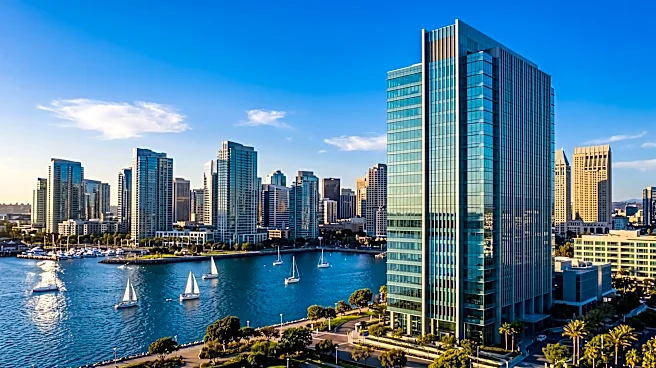
new capital and investors with repositioning expertise into the downtown area, marking the largest office ownership turnover in over a decade, according to JLL. New owners are focusing on upgrading common areas, modernizing elevators, and enhancing tenant amenities to attract demand and justify higher rents. Pricing is diverging across downtown, with bayfront properties in the Westside Columbia District commanding premium rents and values due to views and proximity to amenities, while older buildings in the Core Financial District face a more challenging market. JLL managing director Richard Gonor noted that location now dictates different paths for repositioning and reuse, meaning a downtown address no longer guarantees uniform pricing across office stock.
Why It's Important?
This restructuring of ownership and values in San Diego's downtown office market is important as it signals a broader trend in urban real estate where quality and location are increasingly paramount. The influx of new capital and experienced investors suggests a strategic effort to revitalize and modernize older office spaces to meet contemporary tenant demands. This could lead to a more competitive market for tenants seeking high-quality office environments, potentially driving up rents in upgraded properties while creating opportunities for adaptive reuse in less desirable locations. The emphasis on amenities and modern infrastructure reflects a post-pandemic shift in what businesses prioritize in their office spaces, impacting leasing strategies and property development across the U.S. The divergence in pricing between different downtown districts also highlights the growing importance of micro-location factors within urban centers, influencing investment decisions and urban planning.
What's Next?
JLL anticipates that the long-term transformation of downtown San Diego will increasingly rely on adaptive reuse strategies. Owners of obsolete office buildings are expected to explore conversions into residential, hospitality, or mixed-use developments. Properties in the Westside Columbia District, particularly those near Little Italy and the waterfront, have multiple potential paths for redevelopment. In contrast, eastside assets will likely require more creative strategies to remain viable. Richard Gonor suggests that downtown's broader ecosystem provides a demand base for these repositioning efforts, allowing for diverse strategies where some buildings may continue as offices while others transition to entirely different uses. This indicates a future where the downtown landscape will become more diverse in its offerings, catering to a wider range of urban needs beyond traditional office spaces.
Beyond the Headlines
The ongoing changes in the San Diego office market reflect a deeper evolution in urban real estate, moving beyond simple occupancy rates to a more nuanced understanding of property value based on location, quality, and adaptability. The emphasis on adaptive reuse highlights a growing recognition of the need for sustainable urban development and the repurposing of existing infrastructure rather than constant new construction. This trend could have significant environmental implications by reducing urban sprawl and promoting more efficient use of resources. Furthermore, the shift towards mixed-use developments could foster more vibrant and integrated urban communities, where living, working, and leisure activities are co-located. This could lead to a redefinition of the urban experience, impacting local economies, social dynamics, and the overall quality of life in downtown areas.