


What's Happening?
A U.S.-backed consortium, Frontier Minerals Consortium, has been granted preferred-bidder status to develop Kenya's significant $62 billion Mrima Hill rare earths and niobium deposit. This decision follows a competitive international tender where two
Chinese mining firms withdrew, leaving five international bidders. The consortium comprises U.S. companies Frontier Minerals, ReElement Technologies, and American Resources Corporation, along with Canada-listed Bunker Hill Mining. The U.S. State Department's Bureau of African Affairs has commended Kenya's choice, highlighting the potential for investment, technology transfer, and job creation in both nations. Kenya's Mining Cabinet Secretary, Hassan Joho, announced the consortium as the preferred bidder for one of the country's most valuable undeveloped mineral deposits. This move aligns with Kenya's strategy to attract investors who commit to local processing and refining, aiming to extract more value from its mineral resources beyond raw exports. Frontier Minerals has indicated that local value addition will be a core component of its development strategy, though specific investment figures and timelines have not yet been disclosed.
Why It's Important?
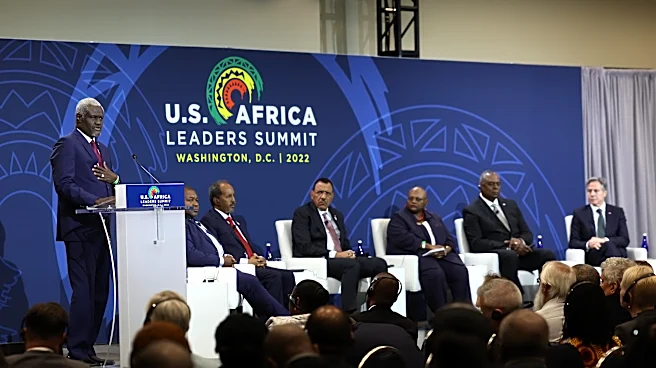
This development is significant as it underscores the intensifying geopolitical competition between Washington and Beijing for influence over critical mineral supplies. Rare earths and niobium are essential for various advanced technologies, including electric vehicles, renewable energy, electronics, and advanced manufacturing. China currently dominates the global rare earth processing industry, and the U.S. is actively seeking to diversify its supply chains through partnerships with resource-rich countries, particularly in Africa. Kenya's decision to award the project to a U.S.-led consortium represents a strategic win for the United States in securing access to these vital minerals and reducing reliance on existing supply chains. For Kenya, the partnership promises substantial foreign investment, advanced technology, and the creation of local employment opportunities, aligning with its goal of fostering domestic processing capabilities and maximizing the economic benefits from its mineral wealth. This project could set a precedent for future resource development agreements in Africa, influencing how other nations balance economic development with geopolitical considerations.
What's Next?
Following the preferred-bidder status, Frontier Minerals Consortium will likely proceed with detailed negotiations and planning for the development of the Mrima Hill project. Key next steps will involve finalizing investment figures, establishing a definitive production timeline, and outlining the specifics of local beneficiation strategies. The consortium will need to detail how it plans to implement local processing and refining facilities in Kenya, which is a priority for the Kenyan government. This project will be closely watched by other nations and mining companies as a model for resource development in the context of global competition for critical minerals. The U.S. government will likely continue to support and monitor the progress of this partnership as part of its broader strategy to secure critical mineral supply chains. The success of this venture could encourage further U.S. investment in Africa's mining sector, potentially shifting the balance of influence in the region's resource development landscape.
Beyond the Headlines
The awarding of the Mrima Hill project to a U.S.-led consortium extends beyond a simple business deal; it reflects a broader strategic realignment in global resource politics. This move highlights the increasing importance of mineral diplomacy, where access to critical raw materials is intertwined with national security and economic competitiveness. The emphasis on local processing and refining by Kenya signals a growing trend among resource-rich nations to move up the value chain, demanding more than just extraction from foreign investors. This could lead to more equitable partnerships and greater economic benefits for host countries, but also potentially higher costs and complexities for mining companies. Furthermore, the withdrawal of Chinese firms from the bidding process, whether voluntary or influenced by competitive pressures, underscores the intensity of the U.S.-China rivalry in Africa. This project could serve as a test case for how Western nations can effectively compete with China's established presence in African resource development, emphasizing technology transfer, local job creation, and environmental standards as key differentiators.