





What's Happening?
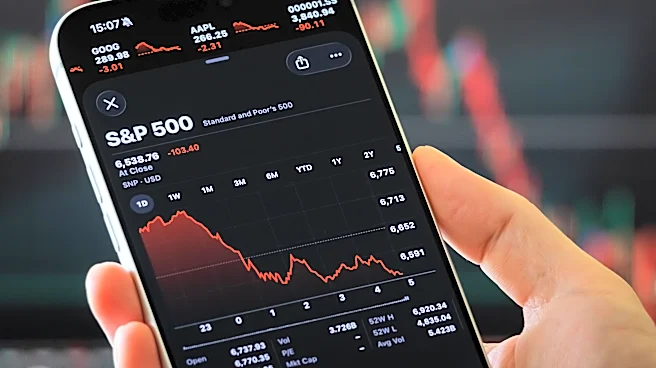
Robinhood Markets (HOOD) stock fell by 9.4% on Friday, November 20, 2026, closing at $62.17, its lowest point in the past year. This decline occurred as the S&P 500 also lost 3.7%, marking its longest losing streak since 2020. The drop followed Robinhood's
introduction of Nasdaq-focused dashboard and live IPO pricing tools on November 19, coinciding with Anthropic's record-breaking IPO. Despite Robinhood's reported double-digit market share growth in equities, options, crypto, and margin, and a revenue increase to $1.42 billion in Q3 2026, the broader technology stock rout significantly impacted its share price. Other companies in the investment banking and brokerage sub-industry also experienced declines, though Robinhood's fall was more pronounced than the median 4.0% drop for its peers.
Why It's Important?
The substantial drop in Robinhood's stock, significantly outpacing the broader market and its sub-industry, highlights the vulnerability of companies heavily reliant on market trading activity during periods of tech sell-offs. Robinhood's business model thrives on customer trading, making it particularly susceptible to market downturns. The company's stock has lost 47.4% over the past 12 months, compared to the S&P 500's 5.3% return, indicating a significant underperformance. This trend could impact investor confidence in growth-oriented fintech companies and potentially lead to increased scrutiny of their valuations, especially given Robinhood's current valuation at 11.0 times its sales over the past 12 months, compared to 3.0 times for the S&P 500.
What's Next?
The continued volatility in the technology sector and broader market could further pressure Robinhood's stock price. Investors will likely monitor market sentiment, particularly concerning tech stocks and IPO activity, as these directly influence Robinhood's trading volumes and revenue. The company's ability to diversify its revenue streams or demonstrate resilience in a challenging market environment will be crucial for its future performance. Furthermore, the performance of its peers, such as Charles Schwab and Coinbase Global, will offer insights into the overall health of the investment banking and brokerage sub-industry and how Robinhood compares within this competitive landscape.
Beyond the Headlines
The pronounced decline in Robinhood's stock, despite its efforts to enhance its platform with new features like IPO pricing tools, underscores a broader market shift where even innovative financial technology companies face significant headwinds during periods of market contraction. This situation raises questions about the long-term sustainability of business models heavily dependent on retail trading enthusiasm, especially as market conditions become less favorable. It also highlights the ongoing challenge for fintech platforms to maintain high valuations when traditional market metrics are applied, potentially leading to a re-evaluation of growth strategies and investor expectations within the sector.