




What's Happening?
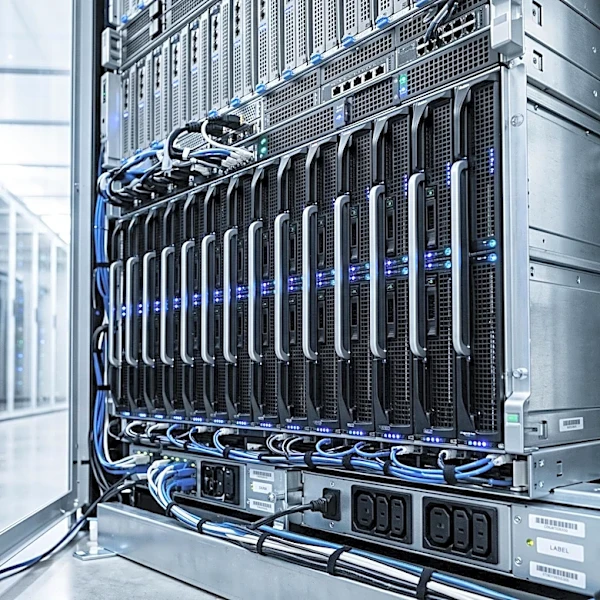
London-based AI cloud company Nscale may be compelled to seek a U.S. export license to continue providing TikTok owner ByteDance with access to Nvidia chips located in data centers in countries like Norway and Iceland. This requirement stems from a new
Commerce Department rule, an interim final rule from the Bureau of Industry and Security (BIS) titled 'Addressing Remote Access to Advanced Semiconductors,' which took effect on November 19. The rule mandates that existing data centers serving companies headquartered in China or other arms-embargoed countries, or ultimately parented by them, must obtain a license within 90 days if they provide more than 12 million aggregate total processing performance (TPP) units. Nscale's September stock-market filing, while not naming ByteDance directly, identified its Singapore subsidiary, Spring (SG) Pte Ltd, as a significant customer. This subsidiary accesses 2,304 B200 chips at Nscale's Glomfjord site in Norway, totaling approximately 83 million TPP, which is roughly seven times the threshold. The 90-day window for Nscale to obtain a license is calculated to close around February 17, 2027.
Why It's Important?
This development is significant as it highlights the U.S. government's expanding efforts to control advanced technology exports to China, even when the technology is hosted in third countries. The new BIS rule closes a 'cloud loophole' that previously allowed foreign infrastructure providers to legally acquire U.S. chips in friendly nations and rent remote access to Chinese enterprises. This move places the burden of compliance on the exporter and host, rather than the Chinese company renting the chips, creating a critical precedent for international technology partnerships. For Nscale, the timing is particularly challenging as it pursues an initial public offering on the New York Stock Exchange. ByteDance's subsidiary, Spring (SG) Pte Ltd, accounted for a substantial portion of Nscale's revenue in 2025 and the first half of 2026, making the potential loss of this customer a significant financial risk. The situation also raises questions for other AI-cloud operators renting large clusters to China-headquartered companies, as they may face similar licensing requirements, impacting their business models and investor confidence.
What's Next?
Nscale has a 90-day window, ending around February 17, 2027, to apply for a U.S. export license to continue its service to ByteDance. Neither Nscale nor the Commerce Department has indicated whether an application will be made or if it would be approved. License applications are reviewed on a case-by-case basis. If a license is denied, Nscale would face the challenge of losing a major customer, which could significantly impact its revenue and its ongoing initial public offering. Nscale has stated plans to dilute ByteDance's share of its revenue through larger contracts with companies like Microsoft and Anthropic, but these contracts are for capacity still being built and may not be fully operational before the license window closes. The outcome of Nscale's situation will set a benchmark for how the U.S. government polices international cloud compute hubs and will be closely watched by institutional research administrators and commercial cloud providers globally.
Beyond the Headlines
The U.S. Commerce Department's new rule has broader implications beyond commercial entities, extending to cross-border academic compute and research security. Historically, U.S. export controls focused on the physical shipment of advanced microelectronics. However, this rule now treats remote access to advanced compute clusters as legally equivalent to physical hardware export under U.S. jurisdiction. This shift means that university research teams collaborating internationally must recognize that providing compute access to researchers affiliated with institutions in Country Group D:5 countries, including China, without proper BIS authorization, could lead to severe administrative sanctions, federal grant debarment, and loss of eligibility for U.S.-origin advanced computing hardware. Research offices and high-performance computing centers will need to implement robust screening protocols to verify the ultimate parentage and physical location of academic collaborators, ensuring compliance with these evolving export controls and safeguarding against inadvertent violations.