
What's Happening?
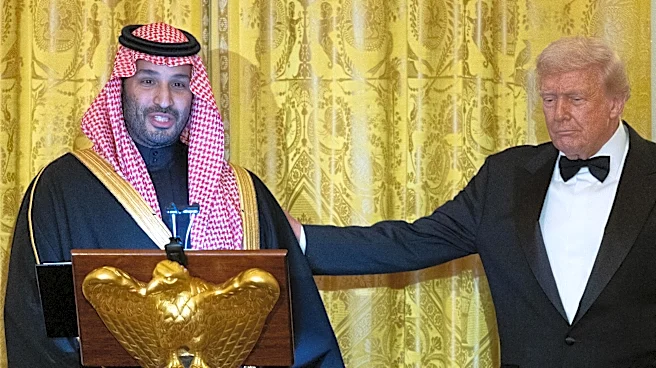
The U.S.-Saudi Business Council's Board of Directors recently convened, with attendance from Saudi ministers including the Minister of Energy, the Minister of Industry and Mineral Resources, and the Minister of Investment,
alongside prominent business leaders from both the United States and Saudi Arabia. The meeting, co-chaired by Lubna bint Sulaiman Olayan and Jane Fraser, reaffirmed the commitment to strengthening the strategic and economic partnership between the two nations. Discussions focused on priorities for expanding bilateral trade, incentivizing investments, and enhancing commercial cooperation across various sectors. The Minister of Investment outlined the upcoming second iteration of the National Investment Strategy, which aims to transform investment opportunities into tangible, realized investments to accelerate economic growth.
Why It's Important?
This meeting of the U.S.-Saudi Business Council is crucial for U.S. economic interests, as it aims to deepen trade and investment ties with Saudi Arabia, a key global energy producer and a significant market for American goods and services. Enhanced cooperation can lead to increased U.S. exports, job creation, and opportunities for American companies in sectors like artificial intelligence and critical infrastructure, as highlighted by Saudi ministers. For U.S. businesses, particularly those represented on the board such as BlackRock, Bank of America, ExxonMobil, Chevron, Alphabet/Google, Delta Air Lines, Honeywell, Cisco, Coca-Cola, Dow, and Lockheed Martin, this collaboration can unlock new revenue streams and market access. Conversely, a stronger economic partnership could also influence U.S. energy security and geopolitical stability in the Middle East, benefiting U.S. consumers and industries reliant on global supply chains.
What's Next?
The U.S.-Saudi Business Council will continue to implement its work program, which focuses on identifying and addressing structural barriers to trade and investment, developing actionable recommendations, and deepening cooperation with government entities and private-sector institutions in both countries. Future discussions will likely center on emerging strategic opportunities to accelerate commercial cooperation and facilitate partnerships in priority sectors. The outlined National Investment Strategy by the Saudi Minister of Investment suggests a proactive approach from Saudi Arabia to attract and convert foreign investments, which U.S. companies will be keen to explore. The Council's ongoing efforts are expected to foster a new phase of institutional collaboration and engagement between the two business communities, with potential for new agreements and joint ventures.
Beyond the Headlines
Beyond the immediate economic benefits, the U.S.-Saudi Business Council's efforts carry broader geopolitical implications. Strengthening economic ties can serve as a foundation for enhanced diplomatic relations and regional stability, particularly in a complex Middle Eastern landscape. The involvement of major U.S. corporations in this council underscores the private sector's role in shaping foreign policy and economic diplomacy. The focus on sectors like artificial intelligence and critical infrastructure also points to a strategic alignment with global technological advancements and national security interests. However, such partnerships also raise questions about human rights, ethical business practices, and the long-term sustainability of investments in a region undergoing significant social and economic transformation. The Council's commitment to addressing obstacles and unlocking new avenues for business will be critical in navigating these complex dimensions.