





What's Happening?
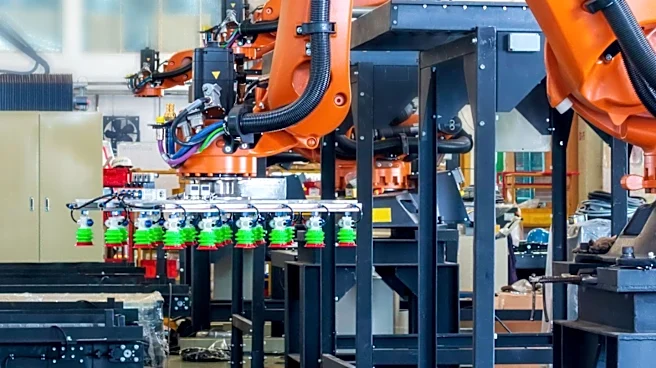
Toyota GAZOO Racing and Yaskawa Electric have implemented an AI-equipped robot for welding frames of the GR Kart. This advanced system, utilizing Yaskawa Electric’s Motoman NEXT robot, has been operational since September at the Gamagori GR Kart Workshop
in Aichi Prefecture, Japan. The robot is capable of checking frame conditions before and during welding, inspecting completed welds, and making necessary corrections. This technology originated from a welding challenge Toyota faced in motorsports, specifically in fabricating race-car roll cages, which previously took two to three weeks but was reduced to about three days with the new Sequence Freezing Arc Welding (SFA) method developed in 2024. The AI robot's ability to recognize variations in frames and adapt its welding process marks a significant departure from conventional industrial robots that follow pre-programmed sequences.
Why It's Important?
This deployment signifies a major advancement in manufacturing automation, particularly in the automotive sector. By integrating AI into robotic welding, Toyota and Yaskawa are enhancing precision, efficiency, and quality control in production. The Motoman NEXT robot's capacity for self-correction and adaptive welding reduces human error and improves the consistency of the final product. This innovation not only lowers the cost of producing the GR Kart but also sets a new standard for factory automation, where machinery can identify and rectify irregularities independently. This approach aligns with Toyota's long-standing philosophy of empowering machines to detect and prevent defects early in the production line, ultimately leading to higher quality and more cost-effective manufacturing processes.
What's Next?
The successful application of AI-equipped robots in GR Kart production suggests a broader adoption of similar technologies across Toyota's manufacturing operations and potentially the wider automotive industry. The lessons learned from this project, particularly in adaptive welding and autonomous quality inspection, could be scaled to other vehicle components and production lines. This could lead to further reductions in manufacturing time and costs, while simultaneously improving product quality and safety. The development also highlights the increasing role of motorsports as a testing ground for advanced manufacturing techniques, with innovations often transitioning from high-performance racing applications to mainstream production.
Beyond the Headlines
The integration of AI into manufacturing robots, as demonstrated by Toyota and Yaskawa, represents a significant step towards fully autonomous and intelligent factories. This shift has profound implications for the future of labor, potentially leading to a redefinition of roles for human workers, who may transition from manual tasks to overseeing and managing advanced robotic systems. Furthermore, the ability of robots to perform self-correction and quality inspection on the fly could lead to a paradigm shift in quality assurance, moving from post-production checks to real-time, in-process verification. This technological evolution could also influence supply chain resilience, as automated factories might be less susceptible to labor shortages or disruptions, ensuring more consistent production outputs.