




What's Happening?
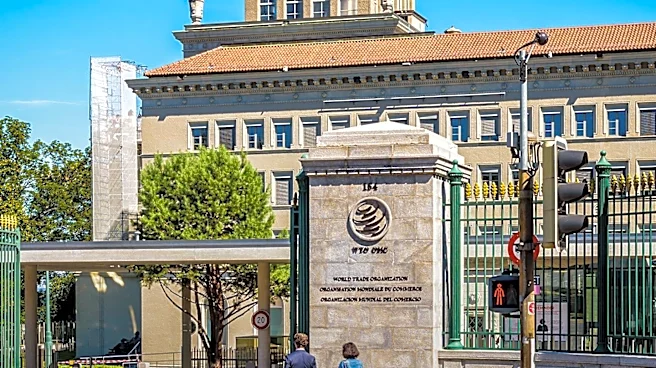
The World Trade Organization (WTO), established on January 1, 1995, to regulate and facilitate international trade, is currently navigating significant challenges. A key issue is the paralysis of its Appellate Body within the Dispute Settlement Mechanism
(DSM), which has raised concerns about the organization's future effectiveness. The WTO operates under agreements covering trade in goods, services, and intellectual property, with core principles like Most-Favored-Nation (MFN) and National Treatment. The MFN principle requires equal treatment among all members regarding trade tariffs and regulations, while the National Treatment principle mandates that imported goods receive no less favorable treatment than domestic products. These foundational principles are now under scrutiny, with the U.S. and EU indicating a desire to re-evaluate MFN, while China advocates for its retention as a cornerstone of the system. Despite these challenges, the WTO continues to manage agreements such as the General Agreement on Trade in Services (GATS) and the Agreement on Trade-Related Aspects of Intellectual Property Rights (TRIPS).
Why It's Important?
The challenges facing the WTO, particularly the paralysis of its Appellate Body and the re-evaluation of core principles like MFN, have significant implications for global trade and, by extension, for U.S. industries and economic stakeholders. A weakened WTO dispute resolution system could lead to an increase in unresolved trade disputes, potentially resulting in retaliatory tariffs and trade wars that disrupt supply chains and increase costs for U.S. businesses and consumers. The U.S. and EU's questioning of the MFN principle could signal a shift towards more bilateral or regional trade agreements, potentially fragmenting the global trading system and creating a less predictable environment for U.S. exporters. Conversely, a more flexible approach to MFN might allow the U.S. to negotiate more favorable terms with specific trading partners. The stability and predictability provided by the WTO's framework are crucial for U.S. companies engaged in international trade, and any erosion of these mechanisms could lead to increased uncertainty and reduced competitiveness.
What's Next?
The future trajectory of the WTO will largely depend on how member states address the paralysis of the Appellate Body and the ongoing debate over core principles like MFN. Discussions are expected to continue regarding reforms to the dispute settlement system, with potential proposals for alternative mechanisms or modifications to the existing structure. The U.S. and EU's stance on MFN suggests that these principles will be a central point of negotiation in upcoming WTO meetings, potentially leading to significant changes in how international trade is conducted. Member countries will need to find common ground to restore the WTO's efficacy and ensure its relevance in a rapidly evolving global economy. The outcome of these discussions will determine whether the WTO can adapt to current trade realities or if its role as the primary arbiter of global trade will diminish, potentially leading to a more fragmented and less predictable international trade landscape.
Beyond the Headlines
The current state of the WTO reflects broader geopolitical shifts and a growing tension between multilateralism and national interests. The U.S. and EU's re-evaluation of MFN, alongside China's insistence on its preservation, highlights a fundamental divergence in trade philosophies among major economic powers. This could lead to a more complex and less harmonized global trade environment, where trade policies are increasingly driven by strategic competition rather than shared principles. The weakening of the WTO's dispute settlement mechanism also raises questions about the rule of law in international commerce, potentially empowering larger economies to exert greater influence without effective checks and balances. This shift could have long-term implications for developing nations, who often rely on the WTO's framework to ensure fair treatment in global markets. The ongoing challenges at the WTO underscore a critical juncture for the future of global economic governance.