






What's Happening?
Xanadu, a Canadian company specializing in photonic quantum computers, has signed a multi-year deal with GlobalFoundries to manufacture its superconducting nanowire single-photon detectors and ultra-low-loss optical wiring on 300 mm production lines in Malta,
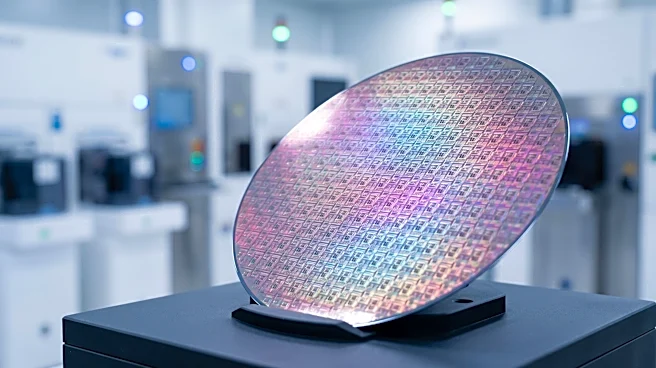
New York. Xanadu's quantum computers use photons as qubits, requiring precise counting of individual photons. The detectors, which are hundreds of times thinner than a human hair and chilled to near absolute zero, register photons by briefly losing superconductivity, creating an electrical blip. This partnership marks a significant step from small-batch, lab-scale production to industrial-scale manufacturing for these critical quantum components. It signifies a move towards treating quantum chip fabrication like a commercial foundry, where various quantum companies can 'bake' their designs at scale, rather than each company producing its own components in-house.
Why It's Important?
This collaboration is a crucial development for the U.S. quantum computing industry, as it brings advanced quantum manufacturing capabilities to American soil. By leveraging GlobalFoundries' 300 mm production lines, Xanadu can achieve economies of scale and improve the reliability and consistency of its quantum components. This move is vital for the commercialization and widespread adoption of photonic quantum computing, as it addresses the challenge of scaling production from experimental prototypes to commercially viable products. For the U.S., this strengthens its position in the global quantum race, fostering domestic manufacturing and technological independence. It also highlights the growing trend of 'picks and shovels' suppliers—companies providing essential components and services—becoming increasingly important in the quantum ecosystem, regardless of which specific qubit technology ultimately prevails.
What's Next?
The partnership will focus on transitioning Xanadu's specialized quantum components to GlobalFoundries' high-volume production lines. This will involve optimizing manufacturing processes to ensure consistent quality and yield of superconducting nanowire single-photon detectors and optical wiring. As these components become more readily available and cost-effective, it will accelerate the development and deployment of photonic quantum computers. This could also encourage other quantum computing companies, regardless of their qubit modality, to explore similar foundry partnerships for scaling their hardware production. The success of this collaboration will serve as a model for industrializing quantum technology, moving it from a research-intensive field to a manufacturing-driven industry. The long-term goal is to make quantum computing hardware more accessible and affordable, driving further innovation and application development.
Beyond the Headlines
This manufacturing partnership represents a broader maturation of the quantum computing industry. It signifies a shift from purely scientific exploration to engineering and industrialization, where the focus moves beyond theoretical breakthroughs to practical production challenges. The decision to manufacture in the U.S. also aligns with national strategies to bolster domestic semiconductor production and secure critical technology supply chains. This could create new job opportunities in advanced manufacturing and high-tech sectors. Furthermore, the 'picks and shovels' approach, where companies provide foundational tools and services rather than complete quantum computers, is gaining prominence. This strategy allows investors to participate in the quantum revolution with less direct exposure to the uncertainties of specific qubit technologies, as these foundational components will be needed regardless of which quantum computing approach ultimately dominates.