





What's Happening?
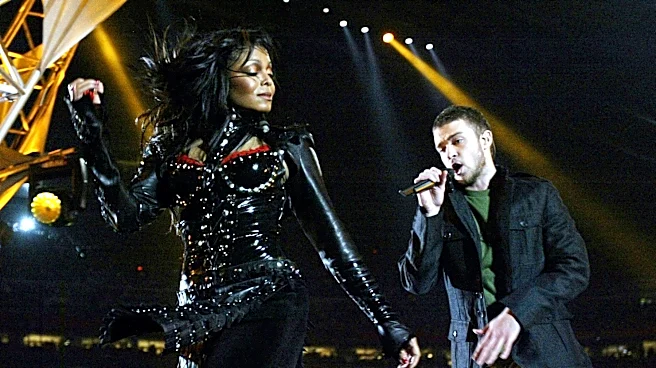
Wayne Scot Lukas, Janet Jackson's longtime fashion designer, has claimed that the infamous exposure during the 2004 Super Bowl XXXVIII halftime show was a planned event, not an accidental 'wardrobe malfunction.' This assertion comes 22 years after the incident,
as Justin Timberlake, who performed with Jackson, prepares to release a four-part documentary series that reportedly covers the event. Lukas, who was not asked to participate in Timberlake's documentary, stated in a Nov. 3 appearance on 'TMZ Live' that the original plan was for Jackson to reveal her backside, but this was changed two days before the show to expose her breast. He also alleged that cameras were supposed to cut away, preventing the moment from being broadcast. Jackson has consistently maintained that the exposure was accidental, making Lukas's account a significant departure from her public explanation.
Why It's Important?
Lukas's allegations are important because they challenge the long-held narrative surrounding one of the most controversial moments in Super Bowl history. The incident led to intense public scrutiny for Janet Jackson, while Justin Timberlake coined the term 'wardrobe malfunction,' which Lukas claims unfairly placed blame on him and Jackson. The designer states that the controversy damaged his professional reputation and cost him work, as he had 'morals clauses' in his contracts. This new perspective could reignite public debate about how Jackson and Timberlake were treated in the aftermath, with many arguing that Jackson bore the brunt of the criticism. It also raises questions about accountability and the media's role in shaping public perception of such events, particularly as Timberlake's documentary is set to revisit the incident.
What's Next?
The release of Justin Timberlake's upcoming documentary series in December will be a focal point, as it is expected to address the 2004 Super Bowl incident. It remains to be seen whether Timberlake's account will acknowledge or contradict Lukas's claims. Lukas has expressed that he is not necessarily seeking an apology but wants Timberlake to address the decisions made before the performance and the subsequent fallout. This renewed attention could lead to further public discussion and potentially new revelations about the event. The controversy's re-examination highlights the lasting impact of the incident on the careers and public images of both Janet Jackson and Justin Timberlake, and how historical events can be reinterpreted years later with new information or perspectives.
Beyond the Headlines
The resurfacing of this controversy delves into deeper issues of gender disparity and media treatment in the entertainment industry. Lukas's claims underscore the argument that Janet Jackson faced disproportionate blame and career repercussions compared to Justin Timberlake, despite both being involved in the performance. The term 'wardrobe malfunction' itself, as Lukas points out, served to deflect responsibility and frame the incident as an accident rather than a potentially deliberate act. This event became a significant cultural moment, influencing broadcast regulations and public discourse on decency. The ongoing debate reflects a broader societal re-evaluation of past events through a contemporary lens, particularly concerning how women in the public eye are scrutinized and held accountable compared to their male counterparts. It also highlights the power dynamics within the music industry and the long-term consequences of public scandals.