




What's Happening?
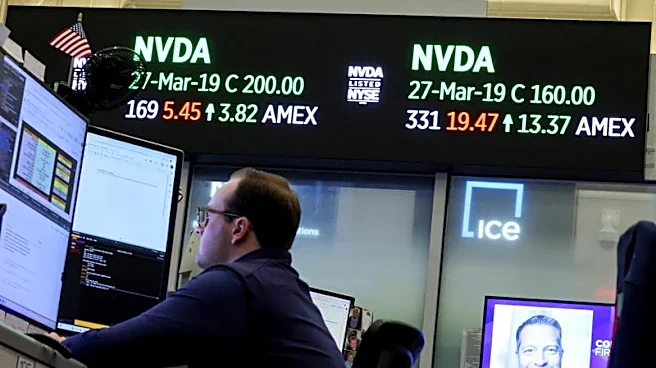
U.S. stock futures are significantly down, indicating a continuation of market volatility as the rally initially sparked by Jensen Huang's return to Nvidia fades. AI stocks are leading these declines, reflecting growing investor caution in the sector.
Precious metals and bond yields are also falling, as investors anticipate fresh tariff hikes and interest rate increases by year-end. The Federal Reserve's preferred inflation gauge, the core personal consumption and expenditures (PCE) index, rose 3.3% annually in October, exceeding the 3.2% consensus forecast. This hotter-than-expected inflation data is likely to solidify another interest rate hike at the central bank's December 8-9 policy meeting, with a 98% probability of a quarter-point increase according to the CME FedWatch tool.
Why It's Important?
The current decline in U.S. stock futures and the underperformance of AI stocks signal a shift in market sentiment, moving away from the recent optimism surrounding artificial intelligence. This indicates that investors are re-evaluating the sustainability and immediate growth prospects of the AI sector. The broader market's reaction, including falling precious metals and bond yields, suggests a flight to safety or a general risk-off environment. The primary driver for this cautious outlook is the persistent inflation, as evidenced by the PCE index. A more aggressive stance by the Federal Reserve, with anticipated rate hikes, directly impacts borrowing costs for businesses and consumers, potentially slowing economic activity and corporate earnings growth. This environment creates challenges for investors, who must navigate both sector-specific concerns in technology and broader macroeconomic headwinds.
What's Next?
The Federal Reserve is expected to raise interest rates at its upcoming December meeting, a move largely cemented by the recent inflation data. This will likely be part of a series of rate increases extending into the new year. The market will continue to monitor the performance of key AI players like Nvidia, which saw a significant pre-market decline, and Anthropic, whose stock is trading below its IPO price. The struggles of these companies, along with Dell Technologies experiencing price target cuts despite strong results, suggest a re-evaluation of valuation multiples in the AI trade. Investors will also be watching for further corporate earnings reports and economic indicators to assess the impact of rising interest rates and inflation on various sectors, including retail, which has seen mixed results.
Beyond the Headlines
The current market downturn, particularly in AI stocks, reveals a deeper re-calibration of investor expectations regarding technological innovation. While AI holds immense long-term potential, the immediate enthusiasm may have outpaced realistic short-term growth trajectories and profitability. The Federal Reserve's response to inflation, while necessary for economic stability, introduces a counter-force to growth-oriented sectors. This dynamic underscores the cyclical nature of market sentiment, where periods of exuberance are often followed by corrections as fundamentals catch up. The challenges faced by companies like Nvidia and Anthropic, despite their innovative contributions, highlight the importance of sustainable business models and clear pathways to profitability, especially in a rising interest rate environment. This period may foster a more disciplined approach to investing in emerging technologies, prioritizing companies with strong financial health and clear competitive advantages.