



What's Happening?
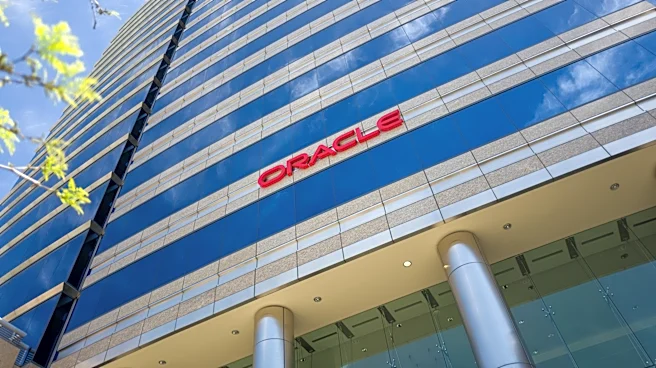
Oracle announced on November 20, 2026, that it has secured all necessary funding to fulfill its infrastructure contract with OpenAI. This funding, totaling approximately $20 billion, was raised through a combination of $10 billion in stock and $10 billion in debt,
with both offerings closing on November 4, 2026. Oracle stated that this makes it the first hyperscaler fully funded for the current investment cycle. The company's statement aims to address concerns regarding its capacity to finance the substantial infrastructure required for the OpenAI contract. While the funding is secured, Oracle's securities filing indicates that the proceeds are for general corporate purposes, meaning the funds are not exclusively ring-fenced for the OpenAI contract. The exact value, duration, or payment schedule of the OpenAI contract has not been disclosed by Oracle.
Why It's Important?
This funding announcement is significant for the AI industry, particularly for the race to develop and deploy advanced AI models. The availability of substantial compute capacity is a critical bottleneck for AI development, and Oracle's ability to finance its infrastructure for OpenAI directly impacts the latter's roadmap and ability to scale its operations. For Oracle, securing this funding reinforces its position as a major cloud provider capable of supporting large-scale AI demands, potentially attracting more AI-focused clients. The claim of being the 'first fully funded hyperscaler' also serves as a marketing advantage, aiming to reassure customers and shareholders about Oracle's financial stability and commitment to AI infrastructure. However, the general corporate purpose designation of the funds means that investors cannot directly trace the $20 billion to specific OpenAI-related expenditures, introducing a degree of uncertainty regarding the direct allocation of these funds.
What's Next?
In the coming quarters, Oracle is likely to face questions from analysts regarding the allocation of the $20 billion, particularly how much will be directed towards the OpenAI contract versus other corporate needs. While Oracle has stated the funding is secured, the lack of a disclosed contract value for OpenAI means that the sufficiency of the $20 billion cannot be independently verified. Competitors in the hyperscaler market may also adopt similar 'fully funded' messaging to reassure their own investors and customers. The role of vendor financing, which Oracle has indicated is in place, will likely become more transparent as suppliers and buyers discuss terms more openly. Future quarterly reports from Oracle will be crucial for investors seeking more detailed insights into capital spending and the financial implications of the OpenAI partnership.
Beyond the Headlines
The Oracle funding announcement highlights a broader trend in the AI sector: the immense capital expenditure required to build and maintain the infrastructure necessary for advanced AI. As AI models become more complex and data-intensive, the ability to finance massive data centers and procure specialized hardware like GPUs is becoming a key differentiator among tech giants. This development also underscores the evolving relationship between cloud providers and AI developers, where infrastructure partnerships are as critical as the AI technology itself. The 'general corporate purposes' clause in Oracle's filing raises questions about financial transparency and accountability in large-scale tech investments, particularly when specific projects are highlighted for funding. This could lead to increased scrutiny from regulators and investors regarding how such significant capital raises are ultimately deployed and whether they truly align with stated project goals.