





What's Happening?
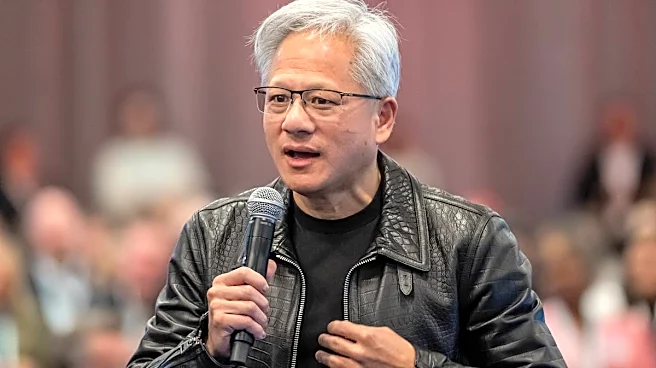
Nvidia CEO Jensen Huang, in an interview with Ezra Klein of The New York Times, posited that the 'junior developer problem' will resolve within two years, with a new wave of 'AI-native' graduates entering the workforce around 2028. Huang argues that while
AI will automate many tasks, the fundamental purpose of engineering—inventing products, solving problems, and connecting social needs with technology—will remain. He believes that students will soon be unable to graduate without proficiency in using and collaborating with AI agentic systems, comparing AI to calculators and personal computers as essential tools. Huang acknowledged that some lower-level skills might fade, but he anticipates that future engineers will be better 'systems thinkers.' He also addressed concerns about AI's impact on junior developers, suggesting that while AI agents will handle more coding tasks, engineers will increasingly focus on checking and verifying AI-generated work, ensuring it operates within defined permissions and boundaries.
Why It's Important?
Huang's forecast has significant implications for the U.S. education system, the technology industry, and the future of work. His prediction suggests a fundamental shift in the skills required for entry-level software engineering roles, emphasizing AI proficiency and systems thinking over traditional coding tasks. This could prompt universities and educational institutions to rapidly adapt their curricula to integrate AI tools and collaborative agentic systems, preparing students for an AI-driven workforce. For businesses, it implies a potential change in hiring strategies, with a greater demand for engineers capable of overseeing and validating AI outputs. The 'junior developer problem,' characterized by reduced hiring of young workers in AI-exposed occupations, could be a temporary phase as the industry awaits this new cohort of AI-native talent. This shift could lead to increased productivity and innovation, but also raises questions about how to provide foundational experience and mentorship for new engineers in an environment where AI handles many traditional apprenticeship tasks.
What's Next?
In the immediate future, educational institutions are likely to accelerate the integration of AI tools and methodologies into computer science and engineering programs to meet the anticipated demand for AI-native graduates. Companies may begin to refine their hiring profiles, prioritizing candidates with experience in AI collaboration and system verification. The industry will also need to address the challenge of providing meaningful apprenticeship experiences for junior developers if AI agents automate many entry-level tasks. This could involve developing new training models focused on AI oversight, ethical considerations, and complex problem-solving. Furthermore, the debate around AI's impact on job displacement versus job creation will continue, with Huang's perspective offering a nuanced view that emphasizes adaptation and skill evolution rather than outright job loss. The next few years will be crucial in observing how these predictions manifest in the labor market and educational landscape.
Beyond the Headlines
Huang's vision extends beyond mere technological adoption, touching upon a deeper evolution in human cognition and problem-solving. By suggesting that future engineers will be 'better systems thinkers' even as 'finer intellectual dexterity' in low-level tasks diminishes, he highlights a potential cognitive shift driven by AI. This implies a future where human creativity and critical thinking are amplified by AI tools, allowing engineers to focus on higher-order problems and complex system design. However, this also raises questions about the potential loss of foundational knowledge and the development of intuition that often comes from hands-on, low-level work. The challenge will be to ensure that while AI handles routine tasks, engineers still develop a deep understanding of underlying principles to effectively debug, innovate, and ensure the reliability of AI-driven systems. This evolution could lead to a more abstract and conceptual approach to engineering, with profound implications for how we educate and train future generations of technologists.