









What's Happening?
Bannerman Energy and its joint venture partner, CNNC Overseas (CNOL), have given final investment approval for the full-scale construction of the Etango Uranium Project in Namibia. The project, with an estimated pre-production capital expenditure of US$353
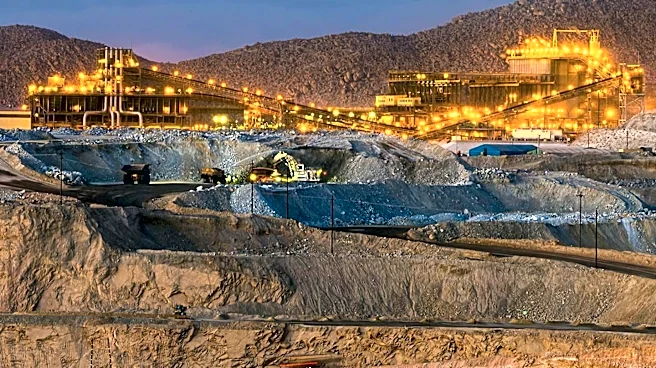
million (approximately $501.9 million), is set to begin construction in the coming months. This decision follows over two decades of exploration and preparation. Bannerman Energy CEO Gavin Chamberlain stated that the project is fully funded on a debt-free basis, supported by a strategic partnership with CNOL and a cornerstone offtake framework. Early works, including bulk earthworks and supporting infrastructure, have already been completed. Commissioning and the first production of yellowcake are targeted for 2028, with an expected annual output of approximately 3.5 million pounds of uranium oxide through conventional open-pit mining and heap-leach processing. A strategic financing transaction of US$320.4 million with CNOL in September established the joint venture and secured funding for debt-free construction. As of September 30, approximately US$64 million had been spent on early works, and the JV held about US$295 million in cash for remaining pre-production expenses. Bannerman also held approximately $175 million to cover its share of working capital through construction, ramp-up, and the start of commercial production. Bannerman Energy holds a 55% stake in the Etango JV, while CNOL, a subsidiary of China National Nuclear Corporation (CNNC), holds 45%. The JV owns 95% of the project, located in Namibia’s Erongo region.
Why It's Important?
The approval of the Etango Uranium Project is significant for the global uranium market and energy security, particularly for countries seeking diversified uranium sources. The project's substantial annual production capacity of 3.5 million pounds of uranium oxide will contribute to meeting the growing demand for nuclear fuel, driven by increasing global interest in nuclear energy as a low-carbon power source. For the United States, which relies on imported uranium for its nuclear power plants, a new major greenfield project entering production could offer an additional supply option, potentially enhancing supply chain stability and reducing reliance on a limited number of suppliers. The involvement of China National Nuclear Corporation (CNNC) through its subsidiary CNOL highlights the strategic importance of uranium resources and the global competition for control over critical minerals. This development could influence international uranium prices and trade dynamics, impacting U.S. energy policy and procurement strategies. Furthermore, the project's debt-free funding model and strategic partnership demonstrate a robust financial and operational foundation, suggesting a high likelihood of successful execution and long-term production, which is crucial for long-term energy planning.
What's Next?
Full-scale construction of the Etango Uranium Project is expected to commence in the coming months, following the completion of early works. The project aims for commissioning and the first production of yellowcake by 2028. Over the next few years, the focus will be on managing the construction phase, ensuring adherence to timelines and budget, and preparing for operational readiness. The successful execution of this project could lead to further investments in uranium mining globally, potentially stimulating exploration and development in other regions. Stakeholders, including energy companies and governments, will closely monitor the project's progress as it moves towards production, assessing its impact on the global uranium supply and market prices. The long-term success of Etango could also influence future strategic partnerships and financing models for large-scale mining projects, particularly in the critical minerals sector. The project's output will eventually feed into the global nuclear fuel cycle, impacting utilities and energy providers worldwide.
Beyond the Headlines
The Etango Uranium Project's approval underscores the broader geopolitical and economic shifts in the global energy landscape. As nations increasingly prioritize energy independence and decarbonization, the demand for critical minerals like uranium is set to rise. The partnership between Bannerman Energy and CNNC Overseas highlights the complex interplay of international capital, resource development, and strategic interests. This collaboration could be seen as a model for future resource projects, where Western and Eastern entities combine forces to secure essential raw materials. However, it also raises questions about the control and influence over critical supply chains, particularly for the United States, which aims to reduce its reliance on foreign adversaries for such resources. The project's success could also set a precedent for environmental and social governance in large-scale mining operations in Africa, given the long development timeline and the focus on sustainable production. The ethical implications of uranium mining, including waste management and community engagement, will remain a critical aspect of the project's long-term impact and public perception.