





What's Happening?
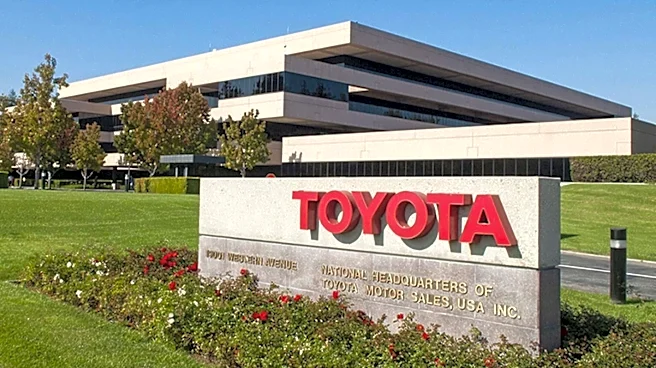
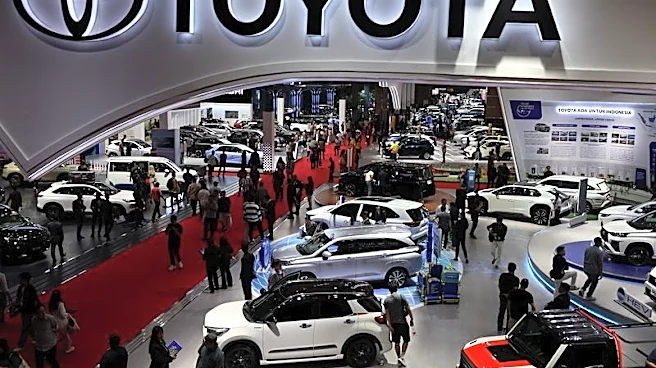
The global automotive industry has experienced a significant reshuffling between 2015 and 2025, marked by the ascent of Chinese manufacturers and major mergers among established players. Toyota has maintained its position as the top automaker, with 11.3
million vehicles sold in 2025, followed by Volkswagen and Hyundai Kia. However, Chinese automaker BYD has emerged as a formidable competitor, selling nearly as many vehicles as Ford in 2025, with sales volumes separated by fewer than 50,000 units. Other Chinese companies like Geely and Changan also reported over 2.9 million vehicle sales each. This shift is partly driven by China's dominance in the electric vehicle (EV) market, where Chinese automakers accounted for 60% of global EV sales in 2025 and over 80% of global battery-cell production. Additionally, the formation of Stellantis in 2021 through the merger of Fiat Chrysler and PSA Group illustrates the trend of consolidation to achieve greater scale and investment capacity.
Why It's Important?
This transformation in the global automotive landscape has profound implications for the U.S. automotive industry and consumers. The rise of Chinese manufacturers, particularly in the EV sector, introduces intense competition, potentially impacting market share and pricing for U.S. automakers. The affordability of Chinese EVs, with approximately 70% costing less than the average conventional car in China, could pressure U.S. companies to innovate and reduce costs to remain competitive. Mergers like Stellantis, which brought together several American and European brands, demonstrate a strategy to pool resources for vehicle development, component purchasing, and new technology funding. This consolidation can lead to economies of scale, but also raises questions about brand identity and market diversity. For U.S. consumers, these changes could mean a wider array of vehicle options, potentially more affordable EVs, but also increased pressure on domestic manufacturing and employment.
What's Next?
The increasing competitive pressure from Chinese electric car exports, which doubled to over 2.5 million in 2025, is expected to continue reaching overseas markets, including the U.S. This trend, coupled with intense competition and squeezed margins in China, incentivizes Chinese manufacturers to seek customers abroad. The U.S. automotive industry will likely need to adapt to this evolving competitive environment, potentially through further technological innovation, strategic partnerships, or policy adjustments. The ongoing shift towards electric vehicles will remain a critical factor, with China's significant lead in battery production and affordable EV offerings posing both challenges and opportunities for U.S. automakers to accelerate their own EV development and market penetration. The long-term success of consolidated entities like Stellantis will also be closely watched as they navigate the complexities of integrating diverse brands and achieving promised synergies.
Beyond the Headlines
The rapid ascent of Chinese automakers and their dominance in the EV supply chain highlight a broader geopolitical and economic shift. China's strategic focus on electric vehicles, supported by significant domestic market penetration and control over critical components like battery cells, positions it as a global leader in a key future industry. This could lead to increased reliance on Chinese technology and manufacturing for EV components globally, including in the U.S., raising concerns about supply chain security and economic independence. The commercial logic behind mergers, driven by the need for substantial investment in new technologies, also points to an era of fewer, larger global automotive players. This consolidation could impact consumer choice and innovation in the long run, as smaller, independent manufacturers may struggle to compete with the scale and resources of these automotive giants. The challenge for U.S. policymakers and industry leaders will be to foster an environment that encourages domestic innovation and competitiveness while navigating the realities of a globally interconnected and rapidly changing automotive market.