



What's Happening?
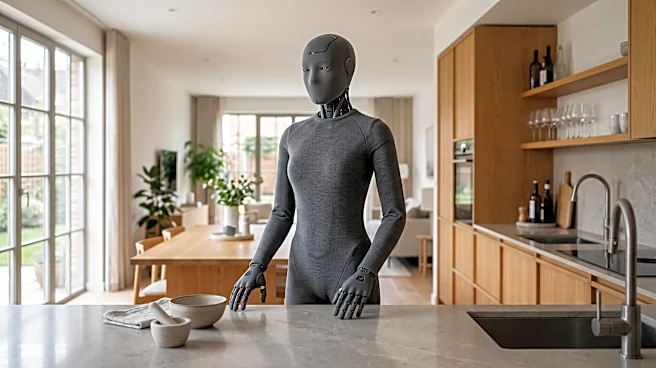
1X Technologies, a company founded in Norway and now based in Silicon Valley, has begun shipping its NEO humanoid robot to early U.S. buyers. The NEO robot, recognized by TIME magazine as one of the year's inventions, stands 165 centimeters tall, weighs
approximately 30 kilograms, and is covered in a soft knit suit. It is designed to perform various household tasks such as fetching items, clearing tables, folding laundry, emptying dishwashers, and carrying groceries. According to founder and CEO Bernt Børnich, NEO's hands are dexterous and human-like, with the robot capable of learning more tasks over time. The robot is priced at $20,000 or can be leased for $499 per month. Pre-orders opened on October 28, 2025, and full production commenced on April 30, 2026, at the Hayward, California factory. NEO can lift over 70 kilograms, carry about 25 kilograms, and operates for approximately four hours on a single charge at a low noise level of 22 decibels.
Why It's Important?
The introduction of the NEO robot to the U.S. market signifies a notable step in the commercialization of humanoid robotics for domestic use. This development could potentially reshape the home automation and personal assistance sectors, offering new solutions for daily chores. While the initial price point of $20,000 makes it a premium product, the leasing option could broaden its accessibility. The target demographic, including elderly individuals and those with disabilities, stands to gain significant assistance, potentially enhancing their independence and quality of life. However, the current reliance on remote human operators for many tasks highlights the ongoing challenges in achieving full robotic autonomy, which could impact consumer adoption and satisfaction. The blend of OpenAI models and 1X's proprietary systems in NEO's operation also underscores the growing integration of advanced AI in practical robotic applications, pushing the boundaries of what household robots can achieve.
What's Next?
The immediate next steps for 1X Technologies involve continuing the rollout of NEO units to early adopters in the U.S. and gathering user feedback to refine the robot's capabilities. As the company aims for broader market penetration, it will likely focus on reducing the robot's reliance on remote human operators, known as 'Turing' operators, to enhance its autonomy and efficiency. Further software updates and AI model improvements are anticipated to enable NEO to perform more tasks independently. The company has indicated that European markets will see the robot introduced in 2027, following the initial U.S. launch. Future developments may include partnerships with healthcare providers or elder care services to integrate NEO into assisted living environments, leveraging its potential to support individuals with specific needs. The success of these early deployments will be crucial in determining the long-term viability and widespread adoption of humanoid robots in residential settings.
Beyond the Headlines
The deployment of the NEO robot raises several deeper implications beyond its immediate functionality. Ethically, the partial reliance on remote human operators for a robot designed for personal assistance brings forth questions about privacy, data security, and the nature of human-robot interaction. The 'Turing' operators, who can take control of the robot, introduce a human element into what is marketed as an autonomous device, potentially blurring the lines of responsibility and accountability. Legally, the framework for liability in case of errors or accidents involving semi-autonomous robots like NEO is still evolving, posing challenges for manufacturers and users alike. Culturally, the integration of humanoid robots into homes could shift societal perceptions of labor, caregiving, and companionship, potentially leading to new social dynamics and expectations regarding technology's role in daily life. The long-term impact on employment in service sectors, as robots become more capable, also remains a significant consideration.