

What's Happening?
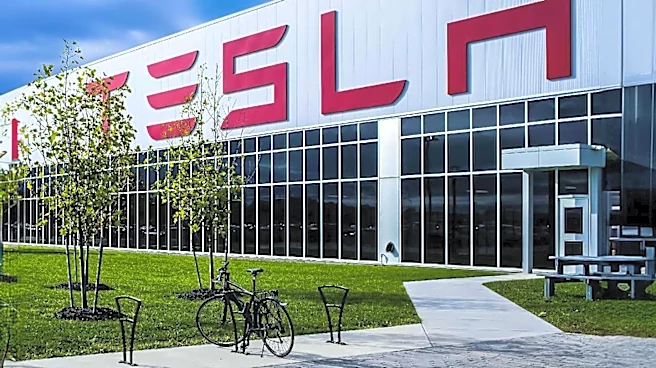
Tesla has submitted plans to Germany's competition authority to acquire EMAG, a German machine-tool manufacturer specializing in equipment for producing gears for humanoid robot joints. While specific details of the transaction remain undisclosed, signs
of the deal have been emerging, including Tesla renaming a shell company to Tesla Machining Technologies Management SE, with its business address at EMAG’s headquarters. EMAG, established in 1867, manufactures turning, grinding, and gear-cutting machines primarily for car drivetrains. The company has been significantly impacted by the automotive industry downturn, reporting a loss of €42 million on €496 million revenue in 2024 and announcing 455 job cuts a year ago. EMAG has also been developing machines for strain wave gear components and planetary gears used in humanoid robot actuators, a capability that addresses a known weakness in Tesla’s Optimus humanoid robot.
Why It's Important?
This acquisition is strategically important for Tesla as it seeks to control the production of critical components for its Optimus humanoid robot. Chief Executive Elon Musk has previously identified the robot's hand as a primary hardware challenge and custom gears as a reliability concern. By acquiring EMAG, Tesla aims to secure an in-house supply of precision gear components, which could become a bottleneck for scaling humanoid robot production to its target of 1 million robots per year. This move reflects a broader trend of companies vertically integrating their supply chains to gain greater control over manufacturing processes and reduce reliance on external suppliers, especially for specialized components. For EMAG, the acquisition offers a potential solution to its financial difficulties stemming from the automotive slowdown, while for Germany, it raises questions about the retention of domestic industrial capabilities.
What's Next?
The acquisition is currently under review by Germany's competition authority. If approved, Tesla will likely integrate EMAG's manufacturing capabilities into its operations, particularly for the production of Optimus robot components. Tesla has already been recruiting in Germany at its Reutlingen site to develop and manufacture Optimus components, including gearboxes and actuators. The Stuttgarter Nachrichten has reported that approximately 220 EMAG employees are expected to transition to Tesla. This integration could accelerate the development and mass production of the Optimus robot, potentially giving Tesla a significant advantage in the burgeoning humanoid robotics market. The move also highlights the increasing convergence of automotive manufacturing expertise with advanced robotics.