




What's Happening?
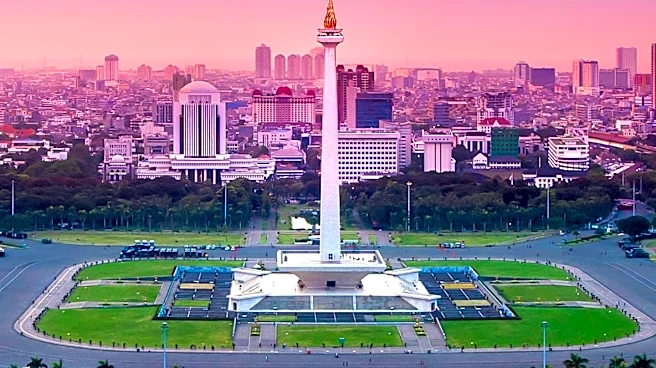
Indonesia's President Prabowo Subianto is pushing for a new commodities exchange, scheduled for launch next year, with the aim of exerting greater control over global prices for its vast natural resources. Indonesia is a major global supplier of palm
oil, nickel, and thermal coal, and a significant source of copper and bauxite. The government intends to make trading through this new exchange mandatory. This initiative is part of a broader effort to expand state influence over natural resources and is seen by some as a nationalist narrative. However, industry veterans and analysts warn that this move risks deterring investors, especially given concerns over a depreciating rupiah, a poorly performing stock market, and economic management. Past attempts, such as the 2023 launch of a palm oil bourse, have seen light transactions and failed to dent the dominance of established exchanges like Malaysia's Crude Palm Oil Futures contract.
Why It's Important?
The success or failure of Indonesia's new commodities exchange has significant implications for global commodity markets and international trade. If mandatory trading on the Indonesian exchange leads to prices significantly higher than on other global exchanges, buyers may seek alternative suppliers or even alternative products, potentially reducing Indonesia's market share. This could particularly affect key commodities like nickel, accelerating the shift away from nickel-based battery chemistries, and coal, where major buyers like China and India are already diversifying their purchases. The move could also push rule-abiding investors out, leaving room for less transparent actors and potentially reducing overall market transparency. For the U.S. and other major economies, disruptions in the supply of these critical commodities could impact manufacturing, energy markets, and overall economic stability. The initiative also highlights a growing trend among resource-rich nations to assert greater control over their natural assets, potentially leading to increased market volatility and geopolitical tensions over resource pricing.
What's Next?
The new commodities exchange is scheduled for launch next year, and its implementation will be closely watched by global markets. The mandatory nature of trading on this exchange will be a critical factor in determining its impact. Industry experts anticipate that building credibility and achieving significant liquidity will be a long and challenging process, as established exchanges have taken years to build trust and international participation. There is a risk that the exchange could become primarily a domestic administrative layer rather than a genuine price-discovery mechanism, potentially increasing compliance costs for businesses and causing investors to delay capital deployment until regulatory clarity emerges. The government's approach to enforcement and its ability to address concerns regarding transparency, legal certainty, and exchange independence will be crucial in shaping the exchange's future and its impact on global commodity trade.
Beyond the Headlines
This initiative reflects a broader global trend where resource-rich nations are increasingly seeking to leverage their natural endowments for greater economic and political influence. Indonesia's move to control commodity prices can be seen as an attempt to capture more value from its resources, moving beyond simply being a raw material exporter. However, the challenges faced, such as competition from established bourses and the risk of deterring investors, underscore the complexities of altering entrenched global market structures. The potential for a 'split market' where the Indonesian exchange serves as an internal reference while global benchmarks remain elsewhere, highlights the difficulty of unilaterally dictating global prices. This situation also brings to light the tension between national economic sovereignty and the principles of free and open international markets, a dynamic that will continue to shape global trade policies and resource governance in the coming years.