







If you want to get a bunch of rowdy firefighters out to a political event on a Monday night, it turns out free beer is a pretty good strategy.
It’s a gorgeous October evening in Missoula, Montana — the state’s second-largest city, at the mouth of the Bitterroot
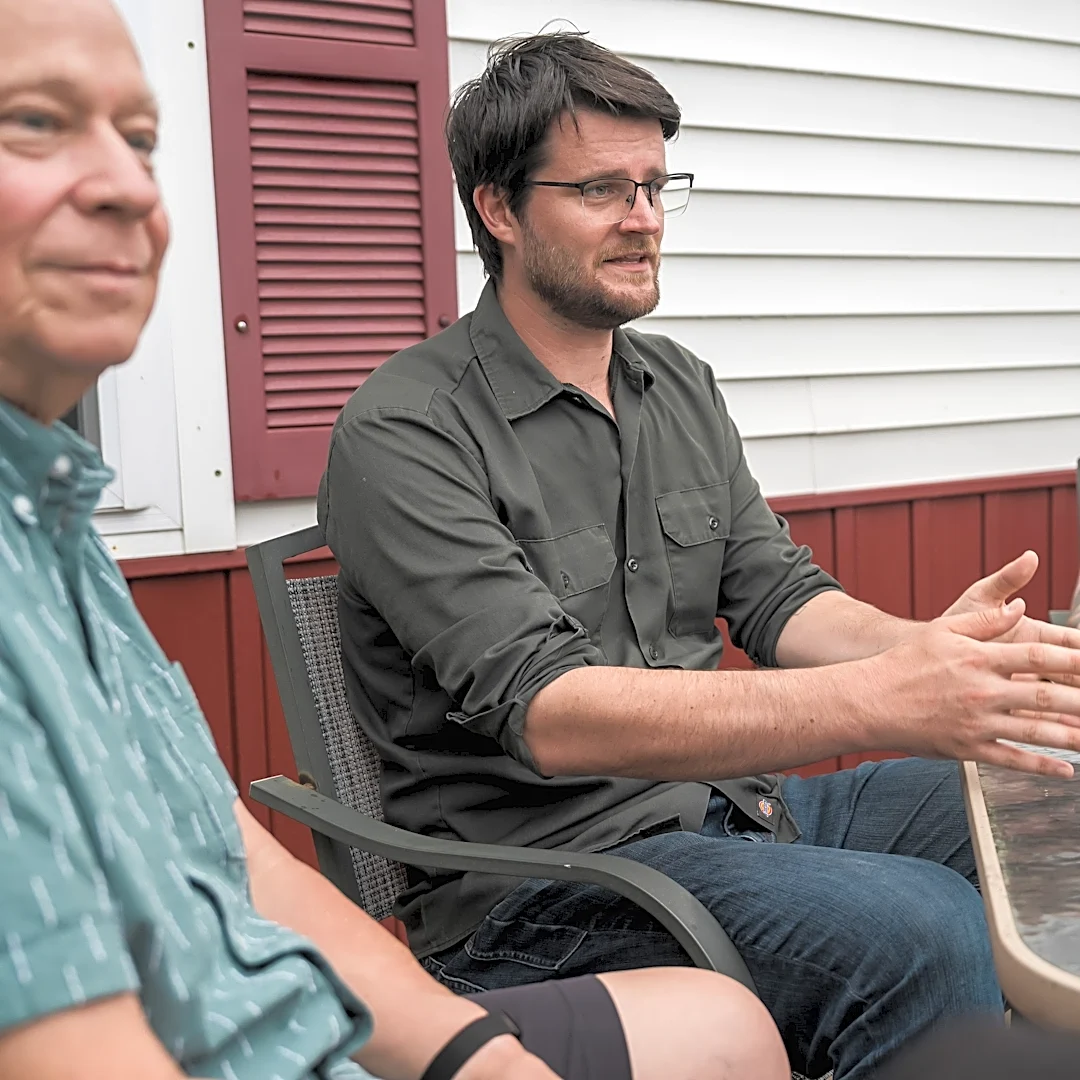
Valley — and Great Burn Brewing is packed to the rafters with wildland firefighters of all stripes. Logging boots. Seven-day beards. Flannels that have seen some shit. Under a big sign that says I HEART BEER, a scruffily handsome congressional candidate named Sam Forstag is on the mic explaining fiscal policy and budget cuts to a crowd more used to talking anchor points and air attack. Still, they’re rapt — because he’s one of them.
Forstag, 32, is an ex-smokejumper — the elite, possibly deranged subset of firefighters who arrive at forest fires by parachuting out of airplanes. He’s running to represent Montana’s 1st congressional district. If he wins, he’ll be the first Democrat Montanans have sent to the House of Representatives since 1994 — the same year he was born. It’s an uphill fight: In the last election, Trump won the district by 12 points. But with four weeks to go, polls show Forstag — a blue-collar economic populist who’s been endorsed by Bernie Sanders and AOC — in a surprising dead-heat. “I’m feeling hopeful,” he tells the crowd. “They’re scared, and they’re spending money like it.”
Forstag is wearing faded Levi’s, work boots, and a t-shirt from his local U.S. Forest Service union. Although he’s a sneaky policy wonk who can happily nerd out for hours about housing subsidies and timber-harvest litigation, tonight he’s serving up pure red meat, firing up the crowd with talk about how costs are too damn high. “The average congressperson — who’s worth $3 to $4 million depending how good the stock market’s doing that day — they legislate like these problems aren’t urgent,” Forstag says. “Let’s elect a working person…so we can go fight for ourselves.”
The crowd whoops in agreement. His buddies circulate with more drink tickets.
Forstag tells a few stories about Montanans he’s met on the campaign trail. People like Kathleen in Columbia Falls, who worked all her life for a Social Security check that barely covers her rent, forcing her to choose between medication and dinner. “At a time when we just minted our first human trillionaire, how do we make sure every working person can afford the basics?” says Forstag. “People are suffering at a deep, deep level here. And it doesn’t feel like the people in power are half as angry as they ought to be.”
He wraps up the rally with an anecdote about a Russian smokejumper who got interviewed in National Geographic a few years back. “He said smokejumping is ‘Three minutes fly like eagle, three weeks dig like mole,’” says Forstag to laughter from the crowd. “I know a lot of you know that feeling. We’ve been digging for a long time.”
THERE’S BEEN A LOT of talk over the past 10 years about how Democrats can win back the white working-class voters they used to have sewn up — the kind who Forstag says “have dirt under their fingernails.” One under-tested approach is to nominate actual working-class candidates. (Like Graham Platner was supposed to be, before the revelations about his trust fund and…everything else.)
Forstag comes by his Carhartt honestly. He grew up in Portland, Oregon, the son of a single-mom nurse who worked night shifts to make ends meet and a single-dad teacher who got by on food stamps. Forstag put himself through the University of Montana working three jobs at a time, including a Subway counter inside a Walmart. After graduation, he took a job on a fire crew to pay off his student loans and start saving up for law school, and worked his way up from rookie to squad boss in just two years. The plan was to do fire just long enough to pay his debts — but in his fifth season, he got picked up by a highly competitive smokejumper crew, where more than half of the uniformly superhuman recruits wash out during the first “Hell Week.” Forstag did not wash out.
“Get paid to jump out of airplanes?” he says, sipping a pale ale at a corner table after his speech. “Sign me up.”
The job of smokejumper combines two objectively insane pursuits — like a bull rider who works exclusively in combat zones. “Any jumper who says they never got scared is full of shit,” Forstag says. “Sometimes you’re on the plane and it’s a wide-open field, and everyone is excited and high-fiving. But sometimes it’s a spot the size of a tennis court and tall timber, and the plane’s pretty quiet.”
Forstag spent the next four summers parachuting into wildfires all over the country, from Alaska to California to Colorado. “Thirty-three fires and 116 jumps altogether,” he says. “You don’t get health insurance. You’re not getting retirement. And I was making 15 bucks an hour.” Wildfire season typically runs from summer through late fall, so during the off-season, Forstag — who majored in political science and was student body president — made extra money working part-time as an organizer and consultant at the state capitol in Helena, lobbying for progressive groups like the ACLU, Planned Parenthood, and the Montana Innocence Project. This has led to absurd GOP attacks that he was “[fighting] to allow sex changes to be performed on children without their parents’ permission.” But Forstag is used to such culture-war distractions.
Wildland firefighters aren’t the most liberal bunch. Forstag was on plenty of jump planes and fire lines with Trumpers and right-wing MAGA bros. “They’d talk to me about whatever crazy shit they saw on Fox — like ‘You can’t have a baby out of your dick’ or whatever,” he says. “And I’d tell them, ‘You know what? You should go to the state capital. We’ve got a 90-day legislative session every other year, and [the politicians] spend two-thirds of it singing and dancing about the sort of shit you see on Fox News and then picking our pockets while we’re looking the other way. They talk about [trans stuff] as if it’s the biggest problem in our lives. I don’t know about you, but the biggest problem in my life is how much money I’ve got.’ By the end of the conversation, they were pretty pissed — and not about the thing we started talking about.”
Forstag didn’t know it then, but this was great practice for talking to voters in Montana — where an influx of multi-millionaires has driven what is, by some measures, the least affordable housing market in the country.
“We’ve been sold this fucking lie that we’re each other’s enemies,” Forstag says. “But the working person on either side of you — that’s not your enemy. Our enemy is the small set of people getting incredibly rich off of these broken systems.”
In 2025, Forstag was elected vice president of his labor union, NFFE Local 60. It had 800 members, most of them from western Montana’s three national forests. But weeks later, Elon Musk’s DOGE embarked on its infamous “efficiency” purge, which included firing 360 Forest Service workers from the state in one day — 85 percent of whom were making less than $20 an hour. One of Forstag’s friends with 15 years on the job was fired while she was undergoing cancer treatment. Another learned he’d been fired via text while on his way to his mother’s funeral.
Talking about Musk tonight, Forstag still sounds pissed. “What the hell does Elon Musk know about high productivity work?” he says. “There’s one guy who’d been jumping for 15 years and was a hotshot [another highly specialized wildland firefighter] for probably 12 years before that. This man spent years without health insurance, making a pittance, beating his body to shit. I remember he said, ‘Man, I knew we had fat to trim in the government — but I didn’t think it was gonna be like this.’ And the reality is, there is fat. But the fat is not people making 15 bucks an hour risking their life swinging a tool. The fat is the corruption. It’s people like Elon Musk, who took $38 billion dollars in tax subsidies. The richest fucking guy in the world.”
Over the next few months, Forstag began mulling the idea of running for office. That September, he drove his 1984 Toyota camper van to his favorite secret lake and decided to go for it. “I had to accept that there’s probably not a job to go back to if I do this,” he says. Federal employees can’t run for office, and his outspokenness about the cuts had already drawn the attention of the Trump administration. (“I had the Secretary of Agriculture’s office calling my boss’s boss’s boss trying to get me fired.”) In December, Forstag wrote his resignation letter while “bawling my eyes out.” A few weeks later, he announced his candidacy.
To outsiders, Montana might seem like one of those vast squareish states that hasn’t gone blue in generations, but they’ve actually elected statewide Democrats pretty recently — including a governor in 2016 and a senator two years later. That said, Montana Democrats are not like other Democrats. (Two of Forstag’s opponents in the primary were an Army veteran-slash-rancher and a Navy veteran-slash-rancher; the third was a former gun CEO.) Accordingly, Forstag isn’t shy about putting space between himself and the national party.
“We hold these truths to be self-evident: The Democratic party fucked up,” he says. “Four years in power at the federal level. Two years of unified control. And people’s lives did not get better. That’s a failure.”
When he entered the race, Forstag’s prospective Republican opponent was Representative Ryan Zinke, the former Interior Secretary under Trump who was the subject of 18 ethics complaints while in office — and perhaps coincidentally, increased his net worth by at least $30 million. The fight was personal: When Forstag’s union members lost their jobs, Zinke — their congressman — wouldn’t return his calls. But in March, Zinke unexpectedly announced his retirement. Now Forstag is running against Aaron Flint, a longtime conservative radio host. Forstag admits he’s disappointed.
“I would’ve loved to beat [Zinke] myself,” he says. “But I’ll beat his hand-picked successor just as happily.”
Forstag’s message is appealingly straightforward. “It’s the incredibly simple notion that you should be able to work one job and afford a roof over your head, health care that actually gets you care when you need it, childcare, and a good retirement. None of that is too much to ask.”
His argument for himself is equally simple. “The people we elect are the policies we get,” he says. “I know what it’s like to be paying your rent on a credit card. I know what it’s like to tear your calf in a wildfire, and limp off three days later in excruciating pain to the only orthopedist in town and have them laugh at you when you present your insurance. There’s an urgency to that experience. And I think that’s most people’s experience.”
The stakes are high for him. When he resigned from his smokejumping job, he also gave up his health insurance and the meager retirement he’d managed to accrue. If he wins in November, he hopes to work on a committee like Natural Resources or Agriculture, where he can do the most for working-class Montanans. And if he doesn’t?
“I’ll be looking for a job,” he says. “’Cause I’m broke.”
Click here to read the full article.