






Writer-director Megan Park may have created the runaway hit of the summer with the teen drama Sterling Point, which captures all of Gen Z’s messiness to a T. So how is she celebrating her success? She’s trapped in bed with a busted foot.
“Funny enough,
I broke my toe at the premiere of the show. And then because my toe’s all messed up, I was walking funny and twisted my ankle. So now the whole foot is just done,” Park says by Zoom from her bed in California. “It’s not the easiest to carry around a two-year-old like this,” the mom of two adds, “but I’ll be OK. If I lose my toe, it’s a memory.”
A native of Canada and a former actor who appeared in teen fare like ABC’s The Secret Life of the American Teenager, Life With Derek, and A Cinderella Story: Once Upon a Song, Park moved behind the camera in her twenties. As a writer and director, she created Fallout, the 2021 school-shooting drama starring Jenna Ortega and Maddie Ziegler. And most recently, she wrote and directed My Old Ass, a time-bending coming-of-age dramedy starring Maisy Stella (The End of Oak Street, Nashville) and Aubrey Plaza playing the young and old versions of the same complicated Canadian girl.
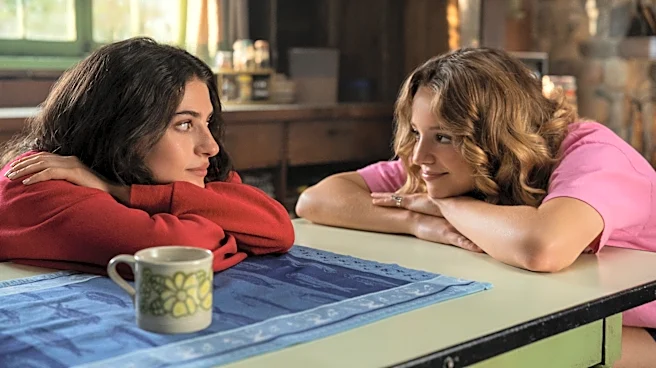
Sterling Point represents a return to Canadian cottage country for Park. Produced by teen drama powerhouses Josh Schwartz and Stephanie Savage of The O.C. and Gossip Girl fame, the series is set in Muskoka, Canada, the same district where Park spent summers growing up, and where she filmed My Old Ass. The show centers on New York high schooler Annie Jacobson (Ella Rubin), whose estranged grandfather has died, leaving Annie and her brother Connor (Keen Ruffalo) a lake house and a Canadian island. Jacobson travels to Muskoka to learn more about her family and the mother she never knew, and finds a cabin with a composting toilet, new friends, and Ramona (Amélie Hoeferle), a sister she didn’t know she had. Since the show’s Aug. 5 release, it’s remained in Prime Video’s Top 5 most popular series, a testament to Park’s ability to reflect Gen Z viewers back to them in a way that feels real.
“There’s so much content out there now. It’s so accessible that the bullshit radar is pretty high for Gen Z. As it should be,” Park says. “There’s a layer of, hopefully, authenticity in Sterling Point. Not talking down to them, and tackling real subject matter that’s universal, about family and relationships and nature versus nurture and grief. To downplay it for younger people makes no sense to me.”
Park spoke about the genesis of the show, how her early career as an actor impacts her as a showrunner, and the prospect of a second season.
After My Old Ass, what made you decide to tackle a YA show?
It’s kind of fun to think about what you can build over eight episodes, eight hours, versus just a movie. It’s also a lot more work, which almost killed me. But I’m still alive.
I come from the world of TV. I spent a lot of time in the YA space when I was acting, so I feel really comfortable in that world and in that format. But I’ve been really passionate about making YA content that feels elevated and real. Why does it have to be really dark or really fluffy? Why can’t it be somewhere in the middle, like life is?
What was your experience with TV growing up? Are there any shows from the past that you’re nodding to in Sterling Point?
Funny enough, I grew up without a TV for most of my life. So I feel like my experiences are actually more about watching movies. I watched Degrassi. Let’s be real, that was a big one for me as a Canadian. Whatever the Drake version was. But I watched Dawson’s Creek and My So-Called Life. I went back and watched things for the first time. I hadn’t seen the first season of The O.C. or Gossip Girl, so I went back and watched those as prep.
You were on some pretty well-known shows — The Secret Life of the American Teenager, Life With Derek. What inspired you to leave acting for writing and directing?
Truthfully, there was a boredom factor that hit me after a while. That era, creativity wasn’t at the forefront of every decision. It was very much, “Don’t ask questions. Stand on your mark, say the lines we tell you to say, and then go sit and wait at video village.” It felt like there was this machine that was like, “This is how many episodes we have to churn out. This is how quickly we have to make them.” We’d never leave the soundstage.
I don’t think I would have continued acting anyway, because I don’t think I was that good at acting. It wasn’t until I started meeting writers and directors who were doing [TV] in a really interesting and cool way. It was like that lightning bolt thing. I was like, “Oh shit, this was what it was all leading towards.” I’ve never looked back. But being trapped as a teenager on a teen show for many years did frustrate me enough to want to do the YA genre justice.
You worked with Shailene Woodley on The Secret Life of the American Teenager. What are your strongest memories from filming?
Secret Life opened a lot of doors for me. It got me my green card and it taught me a work ethic that was really helpful. I was not spending my twenties in L.A. partying. I was working my fucking ass off. There’s a specific episode that does haunt me. Shae and I laugh a lot about an episode called “Just Say Me.” I think [my character] was advocating for masturbating. I blacked it out because it was so traumatizing. There was like a scene in a cafeteria where I think I start a chant? I remember feeling so uncomfortable and icked out. I was like, “I hate these lines and I don’t want to do this.”
I never watched the show back as I was making it. Shae and I keep seeing all these rewatch podcasts, and we’re like, “We should do a first-time watch.” If you were like, “What happened with Shailene Woodley’s character,” I’d be like, “I don’t fucking know.” And same with my own character. There were some interesting moments on that show, for sure.
How has becoming a mother impacted your perception of adolescence?
Being a mom has directly influenced everything I make, because it all stems from questions as a mother I’ve been forced to really think about for the first time. [With] The Fallout, I was living in America. I was thinking about having children [and] was like, “Wait, what am I going to do? Am I going to send them to school here?” That scares the shit out of me. With My Old Ass, it was watching [my daughter] splash in a puddle. It was that immediate fear of time. “Oh my god, it’s slipping away. She’s growing so fast. Am I missing moments of it?” The fear of dying changes when you’re a parent. You’re like, “I can’t leave my children behind.” For Sterling Point, same thing. There’s so much about motherhood and grief. I think being a mom has inspired truly everything I’ve made as a writer. It goes very much hand in hand for me.
You’ve made two projects set in Canada’s cottage country, Muskoka. Why did you decide to run it back?
It’s funny, we never named Muskoka in My Old Ass. It was just supposed to be this nostalgic, timeless place. [With Sterling Point], it was the most natural place. We already had a relationship with people up there. We knew how to shoot up there. We had a great crew that was comfortable filming on water and boats, and this infrastructure pre-built from the movie.
But my personal relationship goes back to being a child. [My family] would spend our summers up there. My dad had recently passed away, and so many of my memories there are of being out on the water with him. It’s a very near and dear place to me. I cut together a little video of my home videos of Muskoka as a kid to Lennon Stella singing “The Rowing Song,” a Patty Griffin cover. She just did it into her iPhone for me. [Stella ended up re-recording the song for the show.] I showed it to Amazon, being like, “This is Muskoka. This is the feeling it brings. This is what I want to bring out of the show.” I played it over Zoom to them and then when I came back [onscreen], they were all sobbing.
What were some of the practical challenges of filming on location?
Filming on the boats is always a fucking shit show, but it’s kind of fun because you’re just out. There’s like a million boats — the camera boat, the hair and makeup boat, the actors. Half the time you lose reception. When Ella and Bo [Bragason, who plays Oona] were doing this spinning, that was really fun, because again, we only had so much control. Ella was really driving that tinner in circles. It was one of the first water scenes we’d shot. There’s a lot of laughing and screaming [performance] notes across the open water.
What driving forces make Annie uproot her life and travel to Muskoka?
She’s somebody who is extremely parentified and, for the first time, realizing this role she’s put herself in. She’s not being told the full story [about her family] and that’s a huge betrayal to her. She really wants to know the truth. But it starts to unravel way more information than she ever obviously wanted to uncover. And it starts to affect everyone else’s lives around her.
What Ella and I talked a lot about is [that] this is a story about a girl who doesn’t define herself as somebody who was adopted. And then by the end of the show, she’s like, “Whoa, I’m a girl with a dead mom.” It’s an interesting arc for her.
How did you choose Ella Rubin as your star?
I know when I see actors. [Ella’s] hair was straight and she was very prim and proper. I was like, “Whoa, that’s totally Annie before she gets to Muskoka.” I remember asking her to come back with no makeup on and her hair natural. She was so unbelievably talented. Her audition was like the best acting I’ve ever seen in my life. As soon as we started chatting about how we saw Annie, it was so clear that we were on the same page. There was no one else in my mind after that.
She’s like Sandra Bullock meets Julia Roberts. She’s like the love child of all of those beautiful women. She can do anything. This girl can cry. She’s an endless well. She’s so great at physical comedy. She’s so funny. She can do anything. It was truly like watching this movie star explode onscreen.
Sterling Point has a bit of a love triangle with Annie and Rory, the rich summer stock played by Daniel Quinn-Toye, and Ellis, the island local played by Jacob Whiteduck-Lavoie. What’s the unique draw of each boy for her?
Rory is somebody that, if Annie had never met Ellis, would be a great guy for her. He’s really in touch with his emotions and his insecurities. He’s also a very parentified child, like Annie is. They really relate on many levels, especially being hard on themselves, and also being very responsible for their parents’ emotions. He’s able to talk about it and pull it out of Annie in a way that she never really has before. He makes her feel really safe and seen. If she was going to go back to New York, he would be a nice [addition] to the life there. He could understand her world but also connect with her on a very deep level.
Ellis is uncomfortable for her, because he quiets her mind and heart in a way that’s really new and scary for her, but very needed. We really tried to make an effort with their scenes to have lots of moments of long silence. There’s no music in their hookup scene. It’s very quiet. Versus Rory, there’s music playing and it’s this crazy club scene. [Ellis] makes her nervous. He’s such a classic Canadian boy. There’s a line where she’s like, “I can’t tell if you like me or fucking hate me.” That’s such a Canadian boy thing. They’re just so quiet sometimes that you’re just like, “What are you thinking? It’s driving me crazy!”
People are obsessed with Annie and Ellis’ first kiss — when he pulls her across the floor. How much of these moments were scripted versus the actors’ intuition?
The floor pull was a collaborative thing that we all kind of figured out together. It was Ella’s idea to put that scene in the closet. The day of, we weren’t really sure how it’s actually going to look and how it’s going to play out. They were trying a few different things. We got down on the floor trying to figure it out. At one point,[someone] pulled me across the floor, and everyone was kind of like, “Whoa, that was hot!” It went from there.
The canoe kiss with Ellis and Annie in the rain was totally not in the script. But it just started pouring rain. We were like, “What if we just tie the canoe up?” We just had to go with it. So that ended up being such an iconic moment on the fly. When you have that collaborative atmosphere on set, and everybody can say an idea and bring something to the table, that’s when those magic moments happen.
How do you make dialogue feel authentic?
You don’t. These are people and they are in my mind. I’m not trying to put lingo in. If cool sayings ever end up in it, it’s improv-y and it’s accidental. The moment you try to start making it [cool], it already feels dated and weird. If [slang] comes out of an actor’s mouth organically, great. But I’m not thinking about them just as young people. That’s where I feel like you’ve already fucking lost the plot. I’m thinking about them as people. Then you pass [things] over to the actor who is young, and they can kind of infuse that life into it in a way that never was on the page. Gen Zis such a misunderstood generation. They’re so wise and have been through such a crazy time in their lives.
With such nuanced and individualized portrayals of adolescence from almost every other angle, it felt a bit glaring — and disappointing — to me that there wasn’t a single Black character. Was that something you all thought about?
I’m sorry you felt that way. I think there’s always room for improvement. We definitely need to have more representation on the show. We always try to cast the best person. It was a little interesting with this because of the genetics of the main characters. You don’t know who [Ramona’s] father is and there would have been some obvious factors. But that’s something for sure we’ve talked about in Season Two.
What’s a scene in the series that you really love?
One of my favorite scenes is [Annie’s] fight with her dad, where she [goes] “I’m the kid.” I’ve gotten a lot of emails from people being like, “I wish I’d been able to have that conversation with my dad or my mom.” [They] definitely feel very burdened by their emotions, even as an adult, and I think that that’s really resonant for Annie, too. That’s where it all comes from. Her need to control and compartmentalize everything is because she feels this crushing burden to make sure that all the balls stay in the air. It’s too much. It starts to break her.
Have you been surprised by the response to Sterling Point?
God, I fucking I ride so hard for Gen Z. Ella and the cast have been sending me [tweets] and the best of the TikToks. I’m like, “They fucking get it.” I love them so much for that. There were so many moments that we all fought to keep in because it just felt so natural and real. There was one tweet of somebody [saying], “These are empathetic big-hearted young people. In any other show, Annie would have been like, ‘Fuck you, Mona, for killing our mom with your fat-ass newborn head.’” I was like, “Ah, you’re right. Thank you for recognizing that.” No show is perfect, and I know some people probably have their beefs about certain things, but I am just so appreciative of the love [because] of the effort that we went to make it feel authentic.
What excites you about the prospect of Season Two? How are you making your case to Prime Video?
Come on, Amazon! What I’m really proud of is that this show is not based on any IP. A bunch of brains came together in the writers room to create this world and these characters. I’m proud of that. That leaves us complete fucking freedom in Season Two to go down whatever path we want to go down. There’s a lot of story to be told, a lot of new perspectives to bring into the fold as well. I just want to do the show and the generation justice and hopefully make as many people feel seen as they possibly can. So I think the more seasons we have to do that, the better. I hope we get that chance.
Click here to read the full article.