





Several years ago, around the time Bernie Sanders’ second presidential campaign was gathering force, my friend Ken Baer said something that stuck with me. Baer, a centrist Democrat who served in Barack Obama’s budget office, told me I was missing a fundamental
shift in the party, which we’d both spent many years thinking and writing about. “It’s not a battle between moderates and liberals anymore,” he said. “It’s between liberals and socialists.”
At the time, this seemed to me a bit dramatic. Sanders defined himself politically as an independent and ideologically as a democratic socialist, rather than as a Democrat, but most of us considered that a distinction without a difference; he had been caucusing with Democrats in Congress for 20 years, and his signature proposals, “Medicare for All” and higher taxes for the rich, hardly made him Eugene Debs. That Sanders could somehow seek the nomination of a party he didn’t even belong to — and never had — tells you how seriously anyone really took his credentials as a socialist.
It seems evident now, though, that Sanders was a Trojan horse. (A clichéd metaphor, I know, but The Odyssey seems to be on people’s minds.) He infiltrated the party and reintroduced the concept of socialism to a generation that had no memory of Soviet bread lines and gulags, Cuban émigrés on rafts, or Britain’s Winter of Discontent. In some ways, today’s democratic socialists are very much the successors to more conventional anti-war movements of earlier eras; in opposing Israel’s relentless war on the Palestinians, they’re raging at the moral unraveling of a played-out generation. But as Baer reminded me recently, there’s a critical difference. This movement isn’t really a movement, or not solely. It’s an actual party, with members and officers and even a line of merch. Where other social movements existed merely to push the Democratic Party further left, democratic socialists are gunning to replace it.
Twenty-five years ago, this would have seemed absurd, the idea that some fringe party with a handful of candidates could seize the house of Franklin D. Roosevelt and John F. Kennedy and remodel it using a blueprint from Animal Farm. But, you know, it’s been a hell of a 25 years in American politics. Colleagues of mine keep writing about this “Democratic establishment,” as if there were still cigar-chomping bosses running vast political machines from the back rooms of Congress. I honestly don’t know what they’re talking about. The closest thing the party has now to entrenched power is a network of labor unions and interest groups (pro-choice, pro-environment, etc.), along with some elite academics and a handful of ideological donors — constituencies that have been all-in for years now on pronoun policing, trans rights, open borders, and punishing wealth. In other words, if there’s anything you can still call a Democratic establishment these days, it looks a hell of a lot more like Elizabeth Warren’s Cambridge than Mayor Daley’s Chicago. (Either of them.)
And it ought to be clear by now that our national parties are really just shell companies with ballot lines, leasable to whomever shows up with a crowd full of zealots and enough cash to secure a convention hall. Obama stormed the Democratic Party in 2008 and supplanted it, for a time, with his own red-white-and-blue abstract image; it was obvious then that Obama’s successes flowed from his own celebrity and would follow him out the door when he left. Then Donald Trump took things a giant step further, staging a hostile takeover of the Republican Party and turning it into a wholly-owned subsidiary of his family business. Trump’s rise proved that you could not only snag a nomination with only a plurality of unshakable voters, but you also could actually win the whole damn thing.
Candidates under the democratic-socialist banner have recently racked up a stunning run of electoral victories, including mayoralties in New York, Seattle, and (soon) Washington, D.C., along with several congressional primaries in Colorado and New York. It seems certain that the party will field a first-tier candidate in the Democratic primaries for president, if not more than one. No wonder there seems to be such warmth between Trump and Zohran Mamdani, a couple of Queens guys who agree on pretty much nothing. However much these DSA Democrats loathe the substance of Trump’s movement, they can’t help but see it as a model.
LOOK MORE CAREFULLY, though, and you’ll see some critical differences between the two. For one thing, the Republican Party is more or less monolithic, unless your idea of a coalition is rich white suburbanites joining hands with poorer white townies. Not so in the Democratic Party, where the road to the presidential nomination — no matter how they ultimately stack the states — will go through large concentrations of Black voters. This was a real problem for Sanders in 2016, and for both he and Warren in 2020, and there’s still no obvious reason to think that socialism plays in South Carolina, or that Black families in high-crime neighborhoods are as excited about defunding the police as college students are.
Of course, the DSA could field a nonwhite candidate like Alexandria Ocasio-Cortez, who is a more effortlessly gifted politician than Sanders and Warren on their best days combined (although Latino candidates don’t necessarily light it up with Black voters, either). But this highlights another critical difference between what Trump pulled off and what the DSA is trying to do: At its core, MAGA has always been more a cult of celebrity than a political movement. Yes, it’s about xenophobia and anti-elitism and nostalgia, but before any of that, it’s about Trump. In the age of weakling parties, political movements grow from electric personalities, not position papers. That could be AOC (who’s enough of a celebrity to get her own acronym), but if she doesn’t run or isn’t any good at it, then the DSA will likely find itself reverse-engineering the modern presidential campaign, starting with a platform and then hiring a messenger. Ask Kamala Harris how that works out.
It’s the platform itself, though, that’s probably the main hurdle standing in the path of a DSA takeover. Whatever you want to say about Trump, the inescapable truth is that a majority of Americans agreed with his most basic arguments, even if they didn’t much like the way he made them. Controlling illegal immigration has been a winning issue in American politics for as long as any of us have been alive. Lower taxes and limited government have been majority positions at least since the 1970s. Trump’s pitch came with an odious whiff of racism and casual cruelty, but the only question facing centrist and conservative voters was whether they were willing to abide all that if it meant getting the policies they wanted. The positions were eminently salable.
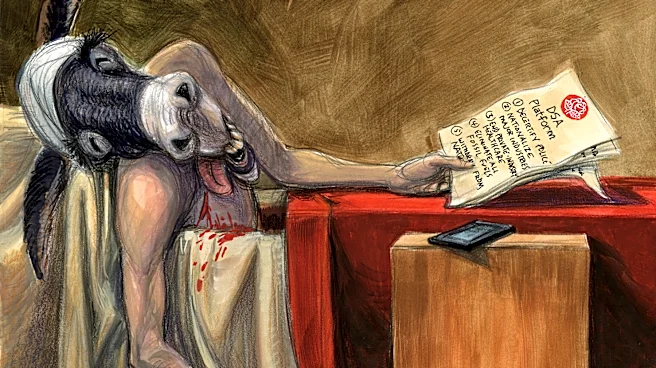
Democratic socialists can claim to be similarly in the mainstream, but unless we’re talking about the mainstream of Portland, Oregon, or Brooklyn, then either they haven’t read their own platform or they’re just not living in reality. In addition to decertifying police unions and taking their guns away, the DSA platform calls for nationalizing a raft of major industries (including real estate and insurance), ending private-industry healthcare, eliminating all fossil fuels, closing all foreign military bases and withdrawing from NATO, and ending all enforcement of immigration laws. Oh, also, the DSA wants to abolish the Senate and let Congress pick the president. That about covers it.
Even if DSA candidates were to disavow whole swaths of that agenda (which is posted on the party’s website), a party that nominates one of them for president can expect to see those positions during every commercial break and in every mailbox for months on end. As Jon Cowan and Matt Bennett, co-founders of the centrist group Third Way, succinctly put it in a Washington Post op-ed: “The organization’s ideas are electoral poison.”
It’s not just those ideas, either — the bigger problem may be what underlies them. Mamdani, who in his inaugural speech actually extolled “the warmth of collectivism,” gave a July Fourth address in which he briefly recounted the nation’s history as a succession of oppressions and betrayals, a class struggle that has always been won by elites peddling the lie of “American exceptionalism.” This shouldn’t surprise anyone; it’s the same way the left has been telling the American story at least since The New York Times published its “1619 project” in 2019. But this was the mayor of New York on the nation’s 250th birthday, and it encapsulated the bitter worldview at the heart of democratic socialism, an essential conviction that America is full of promise but has never been truly good. This is a debatable premise, I guess, but it’s an argument that has never resonated with the American electorate and never will.
In the end, the success of any socialist candidate on the national level will probably rely not so much on how well you can carry the party’s message to the masses, but rather on how deftly you can get some distance from it, blurring the lines between democratic socialism and regular old Democrats. (That some activists are already accusing AOC of ideological slipperiness is probably the best thing that could happen to her.) Before long, the movement Sanders birthed might well become the institutional voice of the Democratic Party. It’s just not necessarily a voice the rest of America wants to hear.
Click here to read the full article.