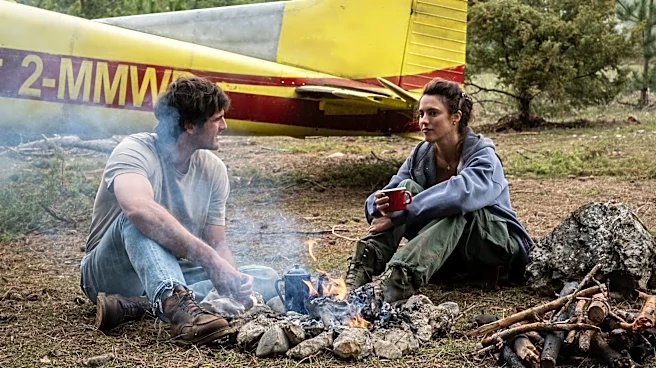



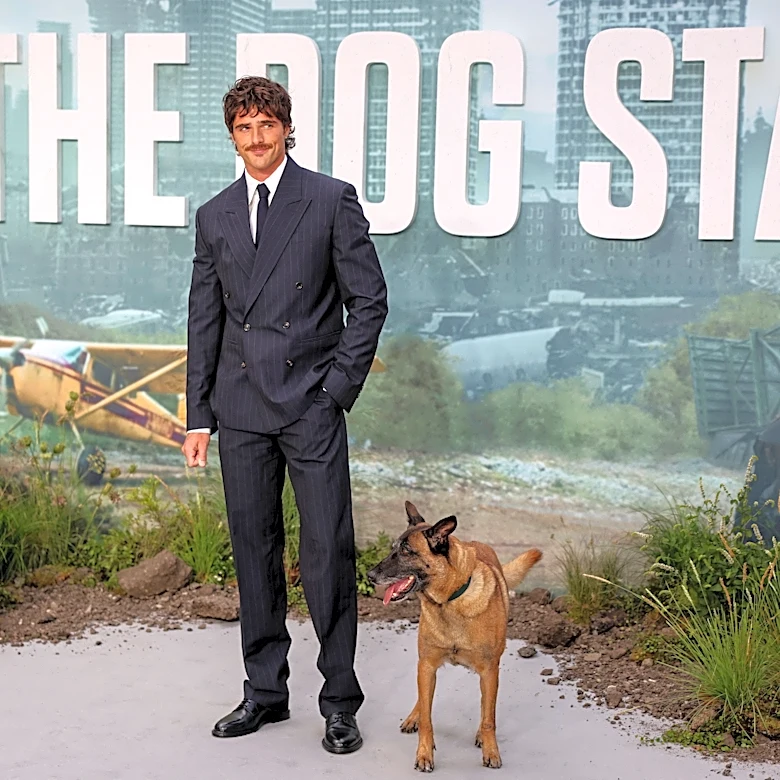


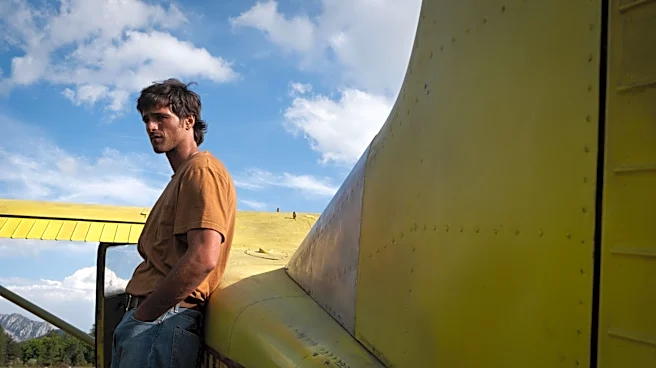


Somewhere just outside the town of Erie, Colorado, you’ll find the rusted-out remains of an airfield that’s home to a boy and his dog. The “boy” is Hig (Jacob Elordi), a twentysomething former mechanic. The dog is a Belgian Malinois named Jasper. The world
they currently live in is both naturally majestic — all that bucolic Rocky Mountain High scenery! — and dystopian, having been ravaged by a flu pandemic that’s taken out roughly 95 percent of the population. Most days, Hig and his faithful pooch hop into his Cessna and scour the ruins of downtown Denver for supplies, fly recon missions, help out the local Mennonite community that’s a short flight away.
Sometimes he’ll stop in to the old apartment he shared with his late wife, which has been preserved as a sort of memento mori museum to the days before everything fell apart. Occasionally, Hig turns off the propeller mid-flight and simply lets the plane drift in the air; the fact that he usually does this while pointing the aircraft at a large mountain in Telluride, one with a lot of backstory-related significance, hints at some troubled thoughts. Mostly, though, this stoic gent and his canine best friend return back to base, which they share with a cantankerous old ex-Marine named Bangley (Josh Brolin). Barring the occasional attack from outsiders, it’s a relatively calm and stable existence, all post-apocalyptic things considered.
The loneliness of the long-distance grieving survivalist is the main preoccupation of The Dog Stars, Ridley Scott’s moody, surprisingly sensitive adaptation of Scott Heller’s 2012 novel. We say “surprisingly” not because the 88-year-old filmmaker is incapable of trying a little narrative tenderness — you can find handfuls of examples in his five decades’ worth of features — but because this type of source material usually brings out the go-for-broke maximalist in him. The knock on Sir Ridley has always been that he’s a production designer trapped in a director’s body, and the man does love a nice, big epic canvas. Especially if it’s attached to a genre exercise that allows for him to craft woozy visual spectacles and meticulously imagined landscapes. There’s a version of this movie that Scott might have made years ago, in which the bulk of its attention would be lavished on its scorched-earth variant of the Mile-High City.
What we get instead is closer to a character study of stoic, psychologically shattered man who, despite having the company of his pooch, a paternal but also possibly psychotic housemate, and a local-ish religious community, is trapped in his own isolation. Look, it’s still a Ridley Scott production. A visit to an abandoned airport outside of town gives way to a highly set-designed 1950s fever dream that David Lynch would applaud, complete with Allison Janney chomping scenery. There are two siege set pieces that come practically back to back, both engineered to inspire their own unique adrenaline spikes. You don’t put a flinty-as-fuck Josh Brolin who makes his own bullets and curates a personal artillery arsenal on the mantle in Act One without making sure he effectively goes off several times during the next few acts. (Hig points out that his mentor in the art of stand-your-ground defense operations actually seems to thrive in this new kill-or-be-killed world order, and after watching Brolin go full commando on feral invaders straight out of a Max Max casting call, it’s hard to disagree.)
Yet The Dog Stars‘ focus remains, dedicatedly and doggedly, on its morose protagonist, and this is why Jacob Elordi proves to be the key element to why the film works as well as it does. The young actor can brood with the best of them, an element that some movies have made great use of (Frankenstein) and others have maybe leaned too heavily on (Wuthering Heights). This film finds a third-bowl-of-porridge option that lets the tall, stark, and handsome star channel both old-fashioned Hollywood strong, silent types and suggest strong undercurrents of pain running mere millimeters beneath the surface. Hig thaws out a bit when an emergency landing drops him in the orbit of a paranoid rancher (Guy Pearce) and his daughter, Cima (Margaret Qualley). The attraction between these two lost souls, both still mourning the loss of their respective spouses years ago, is evident.
But Elordi ensures that, even when Hig’s hope for a better life somewhere out there — perhaps it’s in Grand Junction, where he’s picked up a faint signal of life on the other side of the mountains — becomes the movie’s main motivating factor, everything emotional remains safely tucked away. That the actor is still able to radiate an inner life through the glumness and give you a peek into who this character is (and was) speaks to how well-suited he is to the task. Never mind the Euphoria — The Dog Stars suggests that stolid, steely, and still-waters-run-deep characters may be his secret strength. If nothing else, the movie gives Elordi his true Clint Eastwood moment.
Which makes sense given that, nightmarish dystopian scenario or not, Scott’s movie isn’t science fiction. It’s really a homesteader Western in disguise, right down to the fact that one of the assaults comes from a group of invaders purposefully resembling old-school Apache warriors. There’s even a communal dance scene near the end that might have been lifted directly out of a vintage John Ford movie. And like many of those frontier operas, a solid political reading on this tale is mired in contradictions — one side of the aisle will applaud Brolin’s sneering references to everyone outside his gates as “roaches,” while the other side will note the passing comments about unfortunate, preventable deaths due to vaccine shortages. What you do walk away with is a sense that some things will endure no matter what. Civilizations based on the common good, of course. The need for connection, healing, and continuing to believe that life, yours and others, is worth preserving. And the allure of movie stardom.
Click here to read the full article.