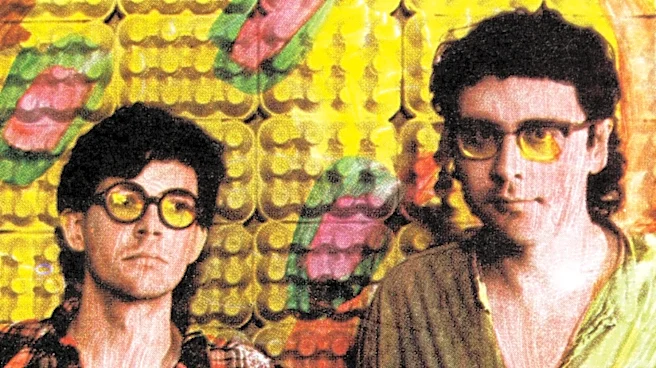



David Fair, who co-founded the influential art rock group Half Japanese with his brother, Jad, died Saturday, Aug. 29. He was 74. Jad confirmed David’s death in an email to Rolling Stone, adding that the cause was cancer.
Fair’s daughter also released
a statement on her father’s Facebook page. “It is with a heavy heart that I announce that my father, David Fair, passed away on August 29th, 2026. He lived a beautiful life of love, kindness, and creativity,” she wrote.
“David was one of those people who showed you that music didn’t have to follow any rules. You could just make something because you needed to make it,” Fair’s label head and friend, Travis McElroy of Thick Syrup Records, wrote on Instagram. “He was a genuinely good, one-of-a-kind human being. I’m thankful our paths crossed and that I got to know him beyond the music. I have a lot of memories that mean even more to me now. It’s hard knowing someone you’ve known and cared about is suddenly just gone. I don’t have anything profound to say. I’m just really fucking sad, and I’m going to miss my friend.”
Jad and David Fair formed Half Japanese in their childhood bedroom and released their first set of home recordings, an EP called Calling All Girls, on their own label, 50 Skidillion Watts, in 1977. As a biography on Allmusic notes, the tapes gained traction in underground circles and the duo eventually signed to a British indie label, which released Half Japanese’s debut album, 1/2 Gentlemen/Not Beasts, in 1980. The sprawling debut featured a mix of home recordings, noise and sound art experiments, wacked-out covers of popular songs, and live recordings that comprised lengthy medleys of additional, barely recognizable covers.
While Jad was always the driving creative force behind Half Japanese, David captured the band’s DIY, free-of-all-constraints ethos in a short but widely-circulated essay, “How to Play Guitar.”
It opened: “I taught myself to play guitar. It’s incredibly easy when you understand the science of it. The skinny strings play the high sounds, and the fat strings play the low sounds. If you put your finger on the string [farther] out by the tuning end it makes a lower sound. If you want to play fast move your hand fast and if you want to play slower move your hand slower. That’s all there is to it. You can learn the names of notes and how to make chords that other people use, but that’s pretty limiting. Even if you took a few years and learned all the chords you’d still have a limited number of options. If you ignore the chords your options are infinite and you can master guitar playing in one day.”
Half Japanese would continue to push their pop experiments in myriad directions, but they also showed a knack for infusing their work with elements of more traditional songcraft and musicality on revered albums like 1984’s Sing No Evil and 1988’s Charmed Life. It all helped turn the band into cult favorites with a few famous fans: Magician Penn Jillette helped the Fair Brothers revive 50 Skidillion Watts in the late Eighties, and in 1993, Nirvana invited the group to open a run of shows on the In Utero tour. (Kurt Cobain was reportedly wearing a Half Japanese shirt when he died.)
While Half Japanese continue to create and release music at a pretty prolific clip, David’s participation was often sporadic. He left and rejoined the group at various points, using his time outside the band to focus on other artistic endeavors.
As a visual artist, he was best known for his playful, eye-popping acrylic paintings, while he also worked as a producer on the surreal web series, The Big Baby Show. Fair and his brother released a handful of albums under their own names outside Half Japanese, with Fair also recording several solo albums, including the soundtrack to the indie film, The Middle Man.
Click here to read the full article.